Number of ‘dumped’ animals soars in BC




On the surface, it sounded like a non-controversial item on the City Council agenda: direct city staff to study and advise on opening up Boulder City’s strict law mandating that all dogs and cats must be spayed or neutered with the desire of some residents to do limited, licensed purebred breeding.
The current law does have an exemption for anyone holding a valid breeder’s permit issued by the state, but there is no option for licensing or regulation of breeding in current city ordinances.
Several members of the public spoke on the desirability of purebred dogs and urging the city to find a way to make breeding legal.
Samantha Jenkins is the resident who first brought this subject up during public comment in a previous meeting. “Responsible, legal and lawful dog breeding is not to over-produce genetically inferior animals for financial gain,” she said. “Being a responsible breeder is a specialized hobby that requires legislation in the supporting jurisdiction.
“People love home-bred dogs because there are rules in place ensuring quality animals who do not have health issues, who have desired traits and are raised in a home environment that prepares animals to be loving, life-long best friends for children, families, veterans and all others.”
But then Ann Inabnitt, Boulder City animal control supervisor, stepped up to the mic for a reality check.
“The Animal Foundation (the main animal shelter in Las Vegas, formerly known as the Leid Animal Shelter) has instituted an eight-week wait to surrender your animal. So if you find out you’re losing your job and you have to take a job in another city and you have to leave right away, you have to wait eight weeks to get an appointment with the Animal Foundation to surrender your pet,” she explained.
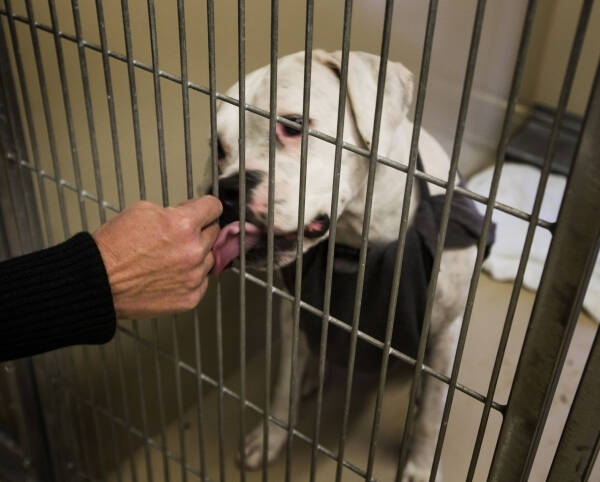
“What does that mean for Boulder City?” she asked rhetorically. “Dumped dogs. We used to get two a year. We’re getting four a week now.”
For those doing the math at home, that is a 100-fold increase.
Inabnitt continued on the subject of purebred dogs. “I have 10 dogs at the shelter now and eight of them were dumped into our community and, interestingly enough, seven of them are purebreds.”
She also noted that 2,200 animals had been euthanized by that shelter last year. (The Animal Foundation is listed as a “no-kill” shelter but that simply means that fewer than 10% of the animals taken in are euthanized).
City Attorney Brittany Walker noted that the proposed changes to city ordinances also envision allowing for what are known as fancier/foster permits which would allow residents, under certain circumstances, to keep more animals on their property than are currently allowed.
Councilmember Cokie Booth expressed zoning concerns and asked if it was possible to limit breeding and fostering permits to the “horse areas” of town, which have more space.
Walker noted that current regulations in Clark County allow for up to eight breeding dogs per property and Booth did the math figuring that, depending on the breed, that could be 80 or more puppies on a property.
“It seems to me like we just need to rein it in,” she said.
Inabnitt continued, “You really need to pay attention to what we’re doing in Boulder City and what we’re encouraging,” noting that other area shelters all report about 50% of their dogs available for adoption are purebreds. “Please don’t buy into the notion that only bad dogs go to the shelter or only mutts go to the shelter or only pit bulls or chihuahuas, because that’s just not true.”
The Boulder City shelter is an “open” shelter, meaning that if anyone —including a breeder —wants to drop an animal off or even an entire litter that needs to be bottle fed, the shelter must take them in.
“I understand that people have the best of intentions,” Inabnitt said. “But in my world I deal only in reality. And the reality is too many dogs. Too many cats. We cannot adopt our way out of this mess. The only answer is to spay and neuter and limit who breeds.”
The council voted unanimously for staff to come back at a future meeting with recommendations.
Contact reporter Bill Evans at wevans@bouldercityreview.com or at 702-586-9401.