CCSD looks at future enrollment; Mixed projections for BC schools



Earlier this fall, the Clark County School District released a comprehensive index report based upon the 2024-25 school year as part of its Facility Master Plan. It included five-year projected growth for each school and enrollment for the 2029-30 school year.
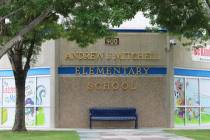
This report will also be used when considering the building of new schools or consolidating others. Five years ago, there was discussion from CCSD about consolidating Garrett Junior High and King and Mitchell elementary schools into a new, K-8 campus. Public input against the idea had the district rethinking that option. It’s not been brought up since. But that’s not to say other alternatives may not be sought in the future.
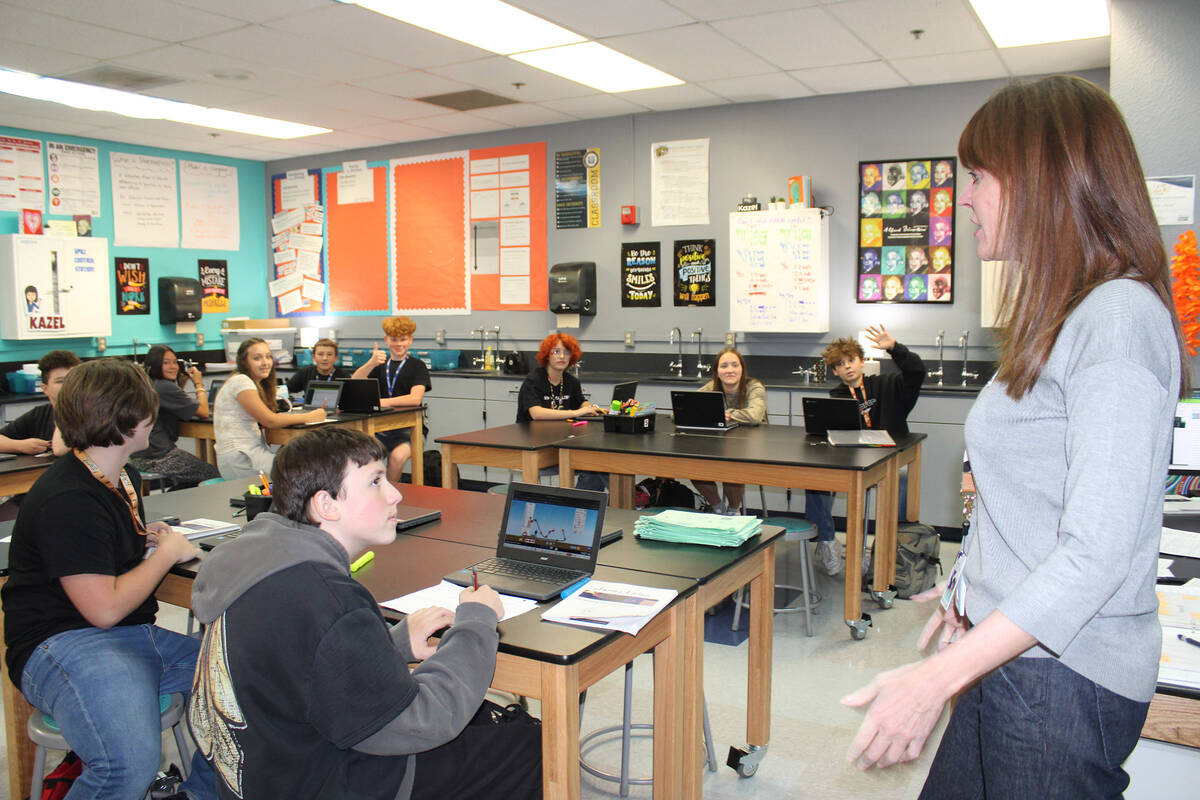
Garrett Junior High Principal Melanie Teemant said there has been discussion as to what Boulder City schools may look like moving forward. That’s because the study showed that enrollment at Garrett, King and Mitchell in the next five years will drop or remain flat, leaving many empty classrooms. And, because of their age, Garrett and Mitchell both need “significant” upgrades.
“The minute you make an upgrade, you’re talking about code compliance. So, that upgrade may look a lot different than just fixing something,” Teemant said.
For now, she added, “There’s no plan on the table as to what things may look like.”
The report shows that Mitchell Elementary had an enrollment last year of 356 kids with a five-year projection to stay nearly flat at 366. Martha P. King, which had 364 students the past school year, is projected to see a 15% decrease in five years from 356 to 329. Garrett is projected to be hit hardest by the 2029-30 school year, going from 399 last year to 329. Boulder City High School, however, is projected to increase by 9% over that five-year period from 616 to 674. It should be noted that this past school year, 30% of BCHS’ enrollment were students from outside of Boulder City through the Choice of School Assignment (COSA) option. That percentage was about half that at Garrett.
The report also gave the capacity of each school and what projected percentage of that will be used by the time the 2029-30 school year rolls around. Mitchell, which opened in 1970, has a maximum capacity of 460 students with a projected 80% utilization by 2029-30. King, opened in 1991, has a maximum capacity of 575, with 54% future capacity anticipated by 2029-30. Garrett, opened in 1978, can house 711 students with 46% future utilization, and BCHS (opened in 2019), has a capacity of 888, with 76% of its seats projected to be filled in five years.
According to its website, the Clark County School District (CCSD) is “developing a Facility Master Plan (FMP) to guide the future of our schools, programs, and facilities for the next decade and beyond. Our families are calling for more choice, newer schools, and innovative programs.”
With community-wide input, the FMP will help shape recommendations that could include:
• New schools
• Rezoning
• Relocated or expanded programs
• Renovations and additions
• Replacement schools
• General maintenance
• New grade configurations
• Repurposing existing facilities
• Possible consolidations
It goes on to state that the challenge is, there’s $15 billion needed in new schools and replacements but just $3.5 billion available in the current bond program. Other challenges include 50,000 open seats in CCSD across the district due to demographics shifts and alternative options. It also states that families want more choices and specialized programs such as preK-8th grade schools and grades 7-12 models.
“These challenges also create opportunities—for students to trade up to schools with more programs and for CCSD to modernize learning environments,” the website states.
This past spring, the district hosted 16 community forums across Clark County to garner input from the community and especially parents.
“Across the district, principles that were repeatedly mentioned included: putting students and learning first and equitable access to quality facilities and educational programs,” the website states. “We also heard an openness to change as we discussed what future options could be on the table and a desire to continue to include students, staff, and the community in the decision-making process.”