Nevada’s Yesteryear: Controversy surrounds lake’s name
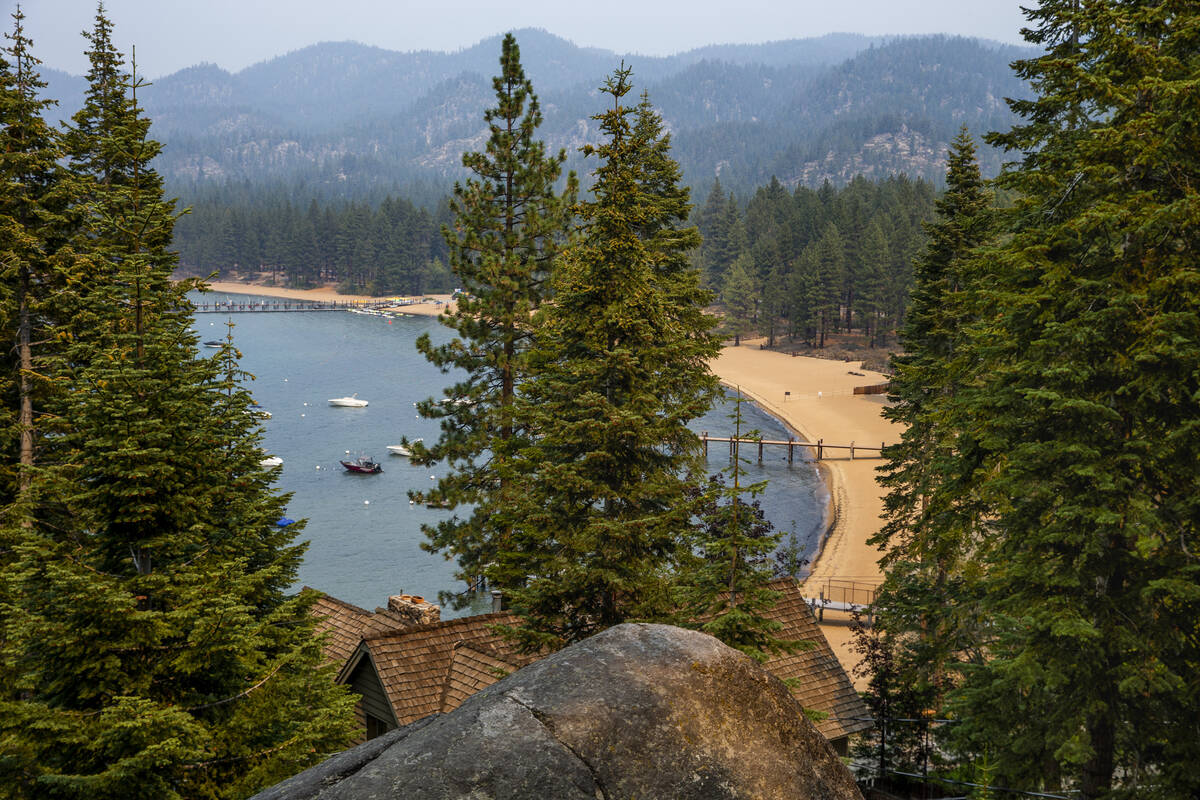



As stated by Nevada historian Phillip Earl, “Few of Nevada’s geological features have had a history of controversy quite like that of Lake Tahoe, which graces the California-Nevada border.”
Discovered by Captain John C. Fremont on his expedition for the U.S. Topographical Corp. in February 1844, Fremont called it Lake Bonpland, out of his admiration and respect for eminent French botanist Aimee Jacques Alexandre Bonpland, an associate of famed German geographer Alexander von Humboldt. However, Fremont’s mapmaker, Charles Preuss, labeled it as “Mountain Lake,” in Fremont’s later reports of his expedition in 1845-46.
Earl notes that European cartographers were very pleased with the name Bonpland, but “American mapmakers, on the other hand, sometimes used the name ‘Fremont’s Lake’ or ‘Mountain Lake,’ and an 1849 U.S. Exploring Map of Upper California carried no name at all for the lake.”
By 1853, the lake was listed as “Bigler’s Lake,” for California Gov. John Bigler (1851-1856). He had led a rescue party in the winter of 1852 into Lake Valley to bring out a group of snowbound immigrants. Upon returning to Hangtown (Placerville), a group of local dignitaries proposed the lake be named for Bigler.
In the intervening years, some maps and immigrants used names like Mountain Lake, Bigler’s Lake and even Truckee Lake.
With the outbreak of the Civil War in 1861, the name Bigler became quite unfavorable.
“The former governor,” Earl wrote, “was an ardent Democrat and vocal supporter of the Southern Cause on occasion. It was suspected he was part of a movement known as the Pacific Confederacy, with hopes to take California out of the Union.”
In addition, Earl wrote “Pro-union (newspaper) editors demanded a change from the Secesh appellation” and called for “no Copperhead names on landmarks for us.”
In 1863, the Indian name of “Teho” was suggested as an appropriate one.
William Henry Knight, a California cartographer, was one of the leaders of the revolt against the name Bigler. He claimed that in 1859 it was known by Washoe Indians as Tah-hoo-ee, meaning “big water” or “water in a high place,” with the main accent on the last syllable. People living around the south end of the lake were known to use the name “Taho” as well.
Earl wrote that some university linguists, such as Prof. Alfred L. Kroeber of the University of California, considered the Indian name to be proper.
“The Washo word for ‘lake’ is da’au or da’aw often pronounced with a ‘t’ sound with the accent on the first syllable. The name ‘Lake Tahoe’ is thus something of a redundancy, technically ‘Lake Lake.’”
Still controversy continued for decades on the proper appeal of the name. Many liked it, many did not. Even Mark Twain was not in favor of it. He claimed the name “would never do justice to the lake’s various wonders and magnificent setting.”
Dan DeQuille (William Wright) of the Territorial Enterprise in Virginia City, and a colleague of Twain at the Enterprise, thought that the lake should have two names, one for the California side and one for the Nevada side.
But the name Bigler never returned for public use in California and for many years in the 19th and early 20th centuries, official road signs by the California highway department did not point motorists and cyclists to Lake Bigler, but Lake Tahoe. Nevada highway road signs though were pretty clear as to where travelers were headed.
Finally, just a month before the end of World War II, on July 18, 1945, (incidentally, two days after the secret first atomic bomb test in New Mexico), the California state legislature officially adopted to change the name of the lake.
“The new law,” Earl wrote, “read as follows, “The lake known as Bigler shall hereafter be known as Lake Tahoe.”
And so it is to this day.
(Adapted from a story by Phillip I. Earl, “This Was Nevada,” Nevada Historical Society, 1986)
Dave Maxwell is a Nevada news reporter with over 35 years in print and broadcast journalism, and greatly interested in early Nevada history. He can be reached at maxwellhe@yahoo.com.