Monument Valley Navajo Tribal Park open
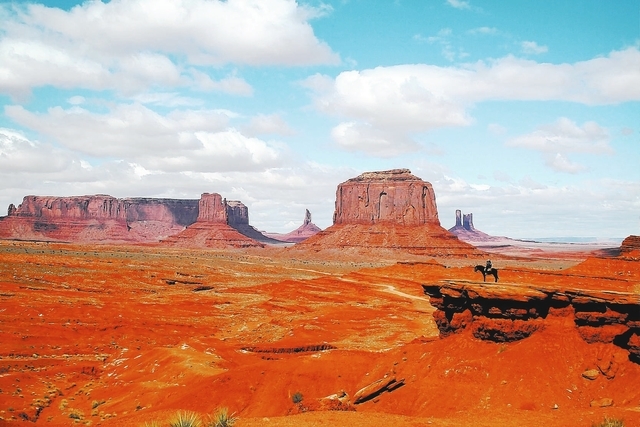



Monument Valley Navajo Tribal Park is home to perhaps the most stunning buttes, mesas, arches and panoramas in the world. So familiar are some of these views, through Western films and television, that even an informal mental list of things to do before “kicking the bucket” often includes seeing them in person.
The fall and winter months are appropriate for the visit, the more so because many closer attractions, on federal land, have been closed due to the budget gridlock. This park, of course, lies not on federal land but the 16 million-acre Navajo Reservation, so it remains open.
The 30,000-acre park was established only in 1958, but the Dine’, as the Navajo people refer to themselves, have occupied this area for more than 400 years. Before that, ancestral Puebloans made homes here.
For Southern Nevadans, just getting to the park requires a fairly long all-day road trip, not counting the visit itself and the return journey. Yet it’s worth investing that much time because the scenery is unlike anything else you will ever see, and because the region is so remote, you won’t have to fight crowds while enjoying it.
The best way to experience the park and see the more remote areas is by signing up for a guided tour. The motor vehicle tours are very worthwhile, but many who can afford the time prefer a horseback version. The horseback tours, especially the full-day ones, will get you off the beaten path to see vistas and cultural sites unavailable from the roads, and you’ll see them surrounded by the profound quiet of the desert.
You can visit at your own pace by taking a 17-mile self-driving tour. But first be sure to pick up the View Scenic Drive brochure, which will fill you in on the names and places of the highlights along the way. And be warned: This drive takes you along a semiloop, gravel road that can be rough in some places. Therefore, a high-clearance vehicle with good off-road tires is a must.
One of the valley’s most iconic formations, the Totem Pole, is visible from guided and self-driven tours. This is a thin spire that rises to an incredible height — about 500 feet over the valley floor. It is instantly recognizable because it has been used so many times for TV and film locations; among them have been TV commercials for IBM and Jeep, and a movie starring Cling Eastwood, “The Eiger Sanction.”
Other films shot partly in Monument Valley include “How the West Was Won,” “Back to the Future III,” “Thelma and Louise” and “Forrest Gump.” The valley’s list of film and magazine credits continues to grow rapidly.
Monument Valley Navajo Tribal Park is open year-round. There is a $5 per person entry fee, but children 9 and younger get in free, as do members of any Native American tribe. The scenic drive is open from 8 a.m. to 4:30 p.m. October through April and 6 a.m. to 8:30 p.m. May through September. For further information, visit www.navajonationparks.org or call 435-727-5874.
Overnight accommodations can be found at Goulding’s Lodge, which offers rooms, suites, cabins and a campground, located 5½ miles from the park entrance; www.gouldings.com, 435-727-3231. The View Hotel is in the park and each unit has a private balcony looking out upon one of Monument’s Valley’s most iconic views — Mitten Buttes — www.monumentvalleyview.com, 435-727-5555.
There are gas stations, restaurants, medical facilities and other services available throughout the reservation, although most are far between. All main roads are paved. No alcohol is sold on the reservation. Arizona does not participate in daylight savings time, but the Navajo Nation does. So during daylight savings time, which ends for the year Nov. 3, the state of Utah and the Navajo Nation are one hour later than Arizona and Nevada. In nondaylight saving months, Arizona, Utah and the Navajo Nation are on Mountain Standard Time, one hour ahead of Nevada.
Many of Deborah Wall’s columns were recently compiled with new information and photos in “Base Camp Las Vegas” and published by Stephens Press. She is the author of “Great Hikes, a Cerca Country Guide.” Wall can be reached at Deborabus@aol.com.