Army seeks DNA to aid in identification of remains




The remains of military combatants whose lives were lost while serving in the military are saved and documented as much as possible for future identification. It’s only in recent years that identification has been made possible by the use of deoxyribonucleic acid, DNA for short. A chemical made up of two long molecules, arranged in a spiral that carries genetic information, it has all the instructions that a living organism needs to grow, reproduce and function. And it codes genetic information for the transmission of inherited traits.
While DNA is regularly referred to in numerous TV crime shows and motion pictures as a tool to identify suspects, it plays a very definite role in identifying soldiers whose remains are otherwise unidentified. Recently, a Southern Nevada widow was contacted concerning such identification by the Department of the Army.
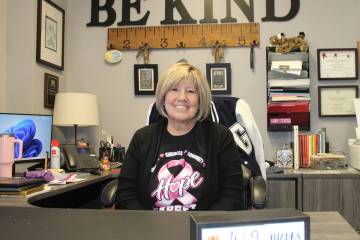
“I was surprised when I was contacted by the U.S. Army,” said Marti Apenbrink. She was informed that remains of several soldiers who had been captured by the Japanese during World War II had recently been discovered, and possible relatives were being asked to submit samples of their DNA in order to ascertain familial genetic confirmations. Some of the remains could be those of Apenbrink’s uncle Joseph Lynch.
Lynch was Apenbrink’s mother’s brother and was one of the defenders of Bataan. After fighting on Corregidor, he experienced the infamous Death March. The “march” forced more than 70,000 prisoners of war to walk some 60 miles while enduring severely inhumane conditions. Many of the men died en route.
Lynch was initially assigned to the Army Air Force, 7th Material Squadron, 5th Air Base Group, and later to the 84th Bombing Squadron in the Philippines. While serving with the latter, he was taken prisoner. It was later reported that he had been transferred to several Japanese “hell ships.” One such ship was the freighter Enoura Maru, which had been initially used to transport horses.
Later, POWs were crammed into the manure-filled bottom holes. According to news reports, the horses had been fed oats and many of the starved POWs scratched through the animal droppings in search of any oats that had not been digested. The ship, one of three that was not outwardly identified as carrying POWs, was bombed while docked at Formosa (now Taiwan). Between bombings and being held in barbaric camp conditions, few survived.
Once Apenbrink agreed to provide her DNA, she received correspondence from the Operations Division of the Past Conflict Reparations Branch, Casualty and Mortuary Affairs, located at Fort Knox, Kentucky. They sent collection instruments from the Armed Forces DNA Identification Laboratory and a Family Reference Collection Form.
“The two-page family reference collection form was very detailed,” Apenbrink said. “It asked for all types of personal identification.” Another form explained instructions for taking a DNA sample. Everything was then packed in a supplied envelope and returned to the Army’s central identification laboratory.
The Army is very specific in that despite its best efforts, it may never be able to account for all the missing, and in fact Lynch’s remains have not necessarily been found.
Holding back emotions, Apenbrink said, “I never knew my Uncle Joe. But I had been told about him while I was growing up. And knowing of his service and sacrifice to the nation, it would give me great happiness if his remains can be identified and given a proper burial.”
Chuck N. Baker is a Vietnam War veteran and a Purple Heart recipient. He can be heard each day on KUNV-FM narrating “America’s Veterans Today and Tomorrow,” one-minute informative news bites.