CEO: ‘We’re always climbing an uphill battle’
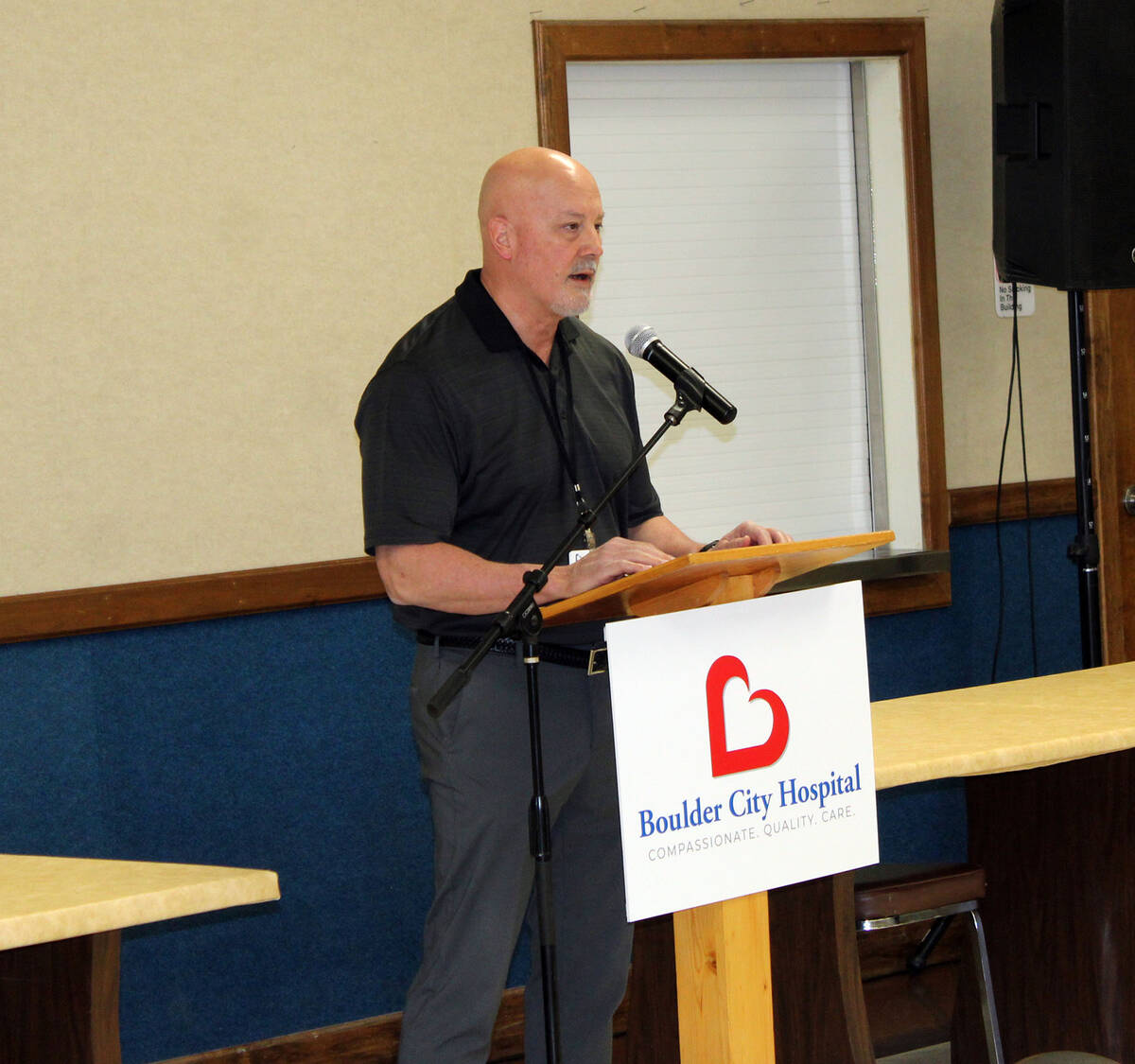




Nearly 100 people turned out last week to hear about changes planned beginning May 1 at the Boulder City Hospital.
The meeting, held at St. Andrew’s Catholic Church, was led by hospital CEO Tom Maher, who spoke for about 20 minutes with the rest of the hour being questions and comments from the crowd regarding the hospital’s upcoming change to a Rural Emergency Hospital.
“I thought the meeting was well-attended and that, for the most part, the questions were pertinent and aided in the general understanding of what this conversion means and the value the hospital brings to the community,” Maher told the Review Monday.
According to the hospital, a Rural Emergency Hospital is a new Medicare provider-type created to keep essential 24/7 emergency care, lab services, radiology, and outpatient services available in rural areas facing financial hardship or potential hospital closures.
Boulder City will be the first hospital in the state to adopt the Rural Emergency Hospital format and just the 45th in the nation.
This model does not include inpatient hospital beds, but it prioritizes rapid emergency care, stabilization, and seamless transfer to partner hospitals when inpatient admission is needed.
If a patient needs to be hospitalized longer than 24 hours, they will be given the option as to which hospital in the Vegas Valley they wish to be moved to, based upon their needs and available beds. Some of this may be determined by insurance coverage, Maher explained. If the patient is not able to articulate a preference, the emergency room physician will make that decision, again, based on the patient’s medical needs and space availability.
The closure of inpatient care services is expected to be permanent.
Maher told the audience that BCH is the only hospital in the state that is not part of a larger organization or one that benefits from a tax district, which is why it has always struggled financially.
“We’re in a small market, which hasn’t changed and I’ve been here 19 years,” he said. “We had about 15,000 people when I started and it’s still about 15,000 people. So, we’re not seeing a lot of growth in terms of patient volume. We’re always climbing an uphill battle.”
He said when COVID hit, the federal funds available (ARPA) helped keep the hospital afloat for a few years but that funding has run its course.
As to the change, the hospital has said:
■ This redefines the rural hospital, focusing on urgent needs rather than inpatient stays, preserving crucial health-care access in underserved communities.
■ Allows small facilities to continue providing emergency and outpatient care while eliminating costly inpatient services.
■ As of early 2026, dozens of hospitals have converted to this status to preserve essential local health-care access in communities where full-service hospitals are no longer financially sustainable.
■ Sustainability: Struggling hospitals with very low inpatient volumes often convert to REH status to eliminate the high overhead of maintaining 24/7 inpatient staffing.
In addition to emergency room services, the long-term, 47-bed care facility will remain. Other services that will continue to be available will include:
■ Primary care clinic
■ Laboratory services
■ Rehabilitation therapy
■ Radiology
■ Community resources
■ Respiratory therapy
■ Outpatient behavioral health
■ Outpatient Surgery
Maher said the change will also save the hospital quite a bit of money, primarily on staffing.
“The reason why the Rural Emergency Hospital type makes sense for us is we’re reducing costs for a very expensive labor-intensive service,” he said. “Acute care staffing is very, very expensive. If you have acute care beds, your staffing for zero (patients) is the same as staffing for six.”
In all, 71 part- and full-time employees will be losing their jobs. The majority of those work within the departments that are being cut.
“It’s absolutely the worst part of this job,” Maher told the Review earlier this month. “Any time you have a reduction in force, sadly, good people often lose their jobs.
“I’ve been here for 19 years and have gotten to know a lot of the employees. We have some who have been here 20 and even 30 years. Again, it’s definitely the worst part of the job having to make those decisions.”
It was shared at the meeting, that of those 71 employees, 16 have been assigned other positions at the hospital.
This status change was made available in 2020 to Critical Access Hospitals and small rural hospitals with less than 50 beds. Each REH receives a fixed monthly payment from Medicare, regardless of patient volume. In 2026, this is $295,000 per month or more than $3.54 million annually, the hospital stated. Maher said this will help ensure the hospital is competitive in terms of salaries and can afford new equipment and renovations to the aging facility, which was built in 1973.