Lawsuit claims ban on ‘useless grass’ has killed 100K trees in Southern Nevada



A well-intended state law mandating the removal of Southern Nevada’s “useless grass” to conserve water has massively backfired, according to a new lawsuit.
Filed Monday in Clark County District Court, the complaint alleges that an estimated 100,000 mature trees throughout the Las Vegas Valley have been a casualty of Assembly Bill 356, a 2021 law that will make it illegal to irrigate certain grass with water from the Colorado River starting in 2027.
That translates to about $300 million in tree damage, according to the complaint, which proudly declares that the plaintiffs “speak for the trees.”
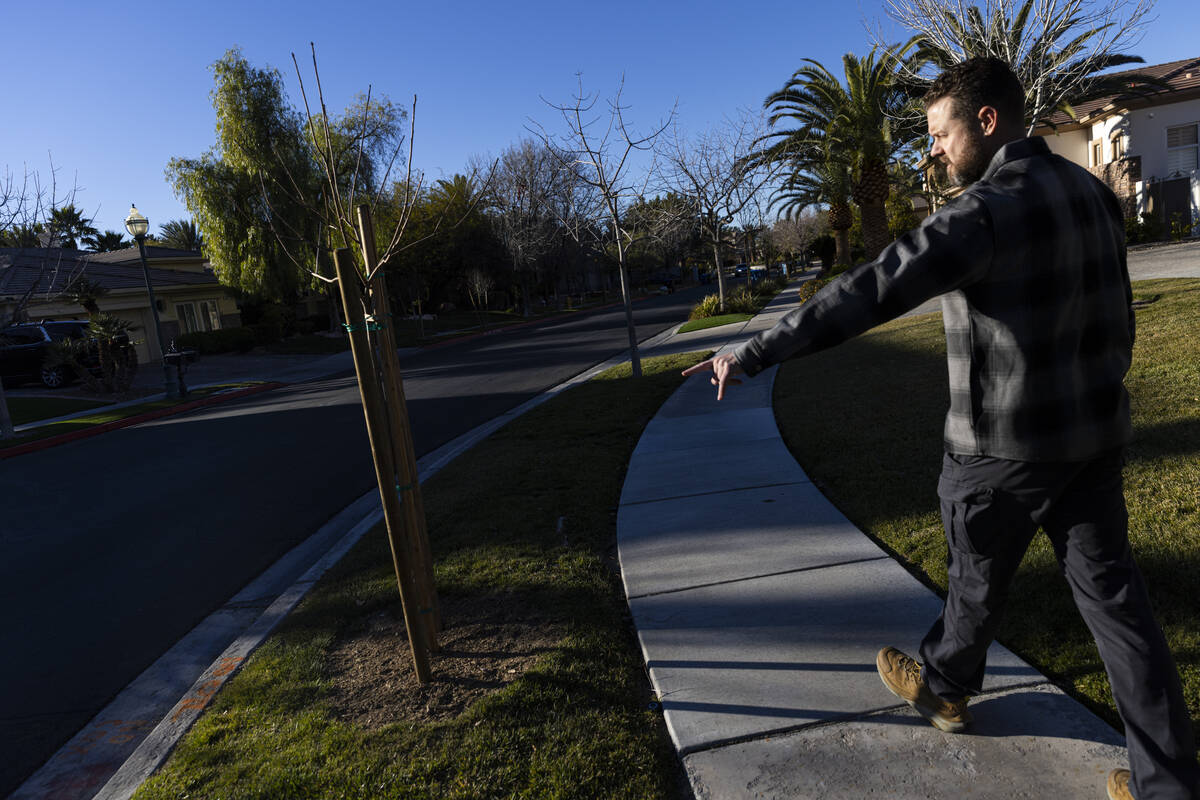
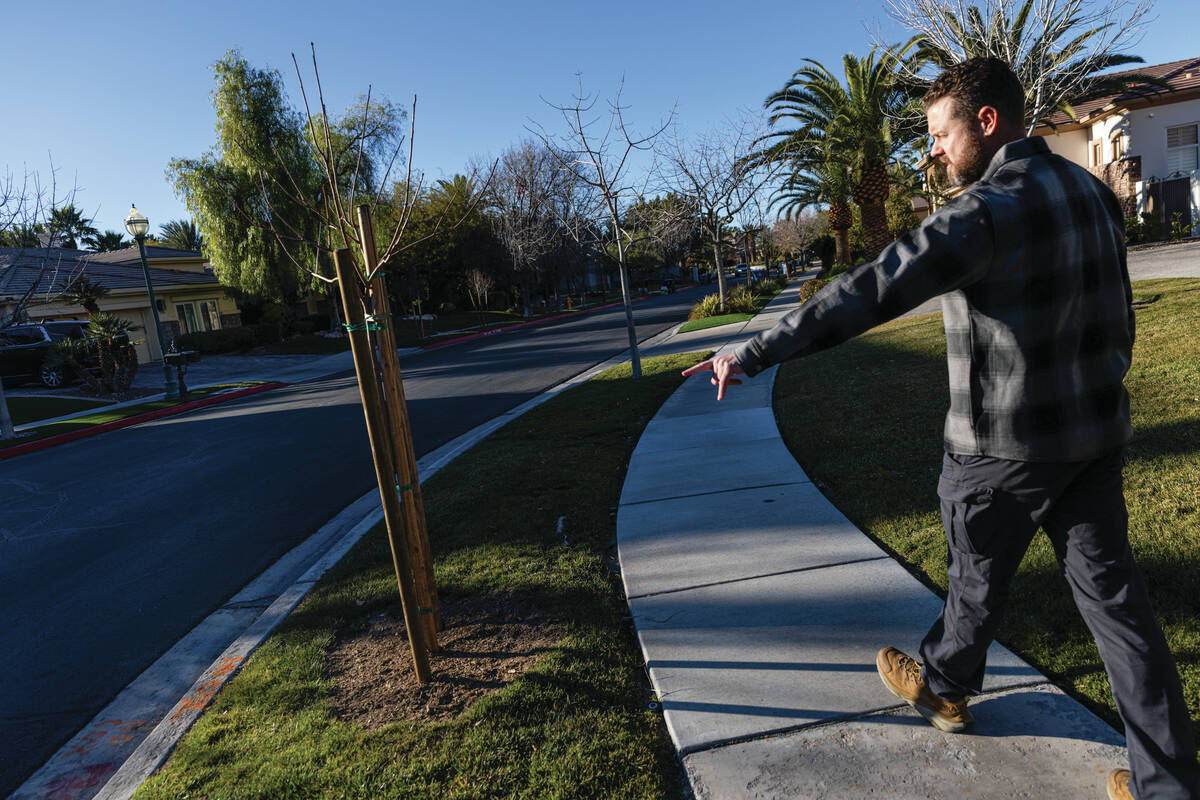
“There have to be alternative ways to conserve water if we really are in jeopardy,” said Kim Snyder, one of the four plaintiffs, who said she has lived in Summerlin’s Canyon Fairways neighborhood for 25 years. “Why are we paying the price to conserve when we are the most conservation-oriented city in the world? Why come after us?”
To implement the law, the Southern Nevada Water Authority convened the Nonfunctional Turf Removal Advisory Committee to determine what constituted “nonfunctional” or “useless” grass, and it unveiled definitions, such as grass that is within 10 feet of a street.
State legislators passed the law in an effort to push water conservation forward as Lake Mead and the Colorado River — Southern Nevada’s main water source — face historic drought amid interstate negotiations forcing seven states to reconcile with how cities, tribes and farms can live with less.
Snyder said the water authority is asking that she and her neighbors strip the grass out of sidewalk landscaping that features dozens of mature trees that provide much-needed shade in boiling desert summers.
Though the science isn’t always consistent about how much trees cool down cities, scientists generally laud them as the single most important and attainable heat-adaptation measure to prevent heat-related deaths in the Desert Southwest.
“We have a beautiful neighborhood that people always say they bought into because of it being green,” Snyder said. “We want to keep it that way, and we have a right to keep it that way.”
Awakening the ‘Henderson tree hugger’
Water authority spokesman Bronson Mack declined to comment on the lawsuit when reached on Wednesday.
Previously, when asked about dying trees throughout the valley, Mack has said many of those trees are a product of mismanagement, with residents or businesses assuming they should not water trees as much after a turf conversion.
Broadly, the lawsuit challenges the water authority’s power to enforce the law. The authority has not publicly said how it plans to enforce the law at the beginning of next year, but it has said in recent board meetings that outreach and education continue.
The lead attorney on the case is Sam Castor, a Summerlin resident with pending litigation against the agency over punitive excessive use charges that he says were unfairly levied against him.
“SNWA claims its interpretations are binding law but they are not,” the new complaint states. “They are not fixed by statute, regulation, or formally adopted rule, but instead exist as changeable website content that may be (and has been) revised at any time without notice, public participation, or legislative or regulatory approval.”
The plaintiffs show that the issue has touched different parts of the valley.
Mark Edington, a cosmetic dentist who lives in a subdivison of Green Valley in Henderson, calls himself the “Henderson tree hugger.” Edington said he runs an Instagram account with the name to educate people that desert landscapes don’t have to be green to be beautiful — and tell them about what he says is overreach from the water authority.
“It’s not the spirit of the law, and not what the politicians sold us when that law took effect,” Edington said in an interview. “We were told that there was no intent to affect community spaces, and that it would not affect our parks. Those were lies. Now, it’s become a chase to see how far we can go. We don’t know what the endgame is.”
He and his wife, Jenny Lynne Edington, who are plaintiffs in the case, are largely concerned about the removal of grass under trees at a nearby park and the trees that died after their homeowners association tore out grass below them on streetscapes.
‘Decades for the Las Vegas Valley to recover’
Laura McSwain, founder of the local Water Fairness Coalition that has pushed back on water authority measures, said she helped Castor organize plaintiffs for the lawsuit. Over the past three years, she has heard from hundreds of valley residents who are fed up with the status quo, she said.
“My goal has never been to save every blade of grass in the valley,” McSwain said. “But it’s the sensitive areas. It’s the areas that preserve our quality of life, that protect the trees, that protect wildlife.”
Attached to the lawsuit is a declaration from Norm Schilling, the owner of Mojave Bloom Nursery in downtown Las Vegas and a Southern Nevada horticulturist of 35 years. Schilling broke down the estimates of the 100,000 trees and $300 million worth of tree damage, adding that many trees cannot go on living once grass is disturbed.
“Beyond monetary loss, the green mature canopy (and its heat mitigation benefits) cannot be replaced quickly,” Schilling wrote. “It will take decades for the Las Vegas Valley to recover, if it can at all.”
The complaint says Schilling estimated that less than 10 percent of trees in the Las Vegas Valley survive the removal of their grass cover, but Castor later said that misrepresented the declaration. Schilling said “many trees do not survive the conversion,” according to Castor.