Council requests clarification on energy storage

It was supposed to be a technicality, but it led to a different discussion.
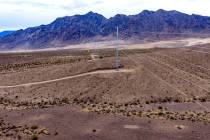
City staff is advising the council to consider adding an additional 258 acres divided among seven smaller plots of land in the Eldorado Valley to the Land Use Plan for possible future consideration for rezoning to allow for additional energy development.
Development director Micheal Mays was clear that this was just the beginning of a long and public process and that it did not mean any additional action or development would ever happen.
“The land management process requires that all additional parcels to be added to the list come before the city council. The city council then decides if they want to entertain that and forward it on to the planning commission. The planning commission evaluates at a public meeting and then provides a recommendation. Then it comes back to you as a city council to determine whether to add it to the list or not,” he said.
“Whenever parcels are added to the list,” Mays continued, “it does not mean those parcels are going to be developed. It does not mean they are going to be leased and/or sold. There are other steps involved in that process that include negotiations, requests for proposals and in many cases reconsideration of zoning and the master plan. This is the initial step.”
May emphasized that part of the process was determining a possible future use for land added to the land management list was determining a possible future use, in this case, energy and utility uses. Part of the reason for the multi-stage process is to give the public a chance to provide input early because if later someone came to the council with a proposal for a different use, it would restart the entire process. However, no members of the public came forward to speak during the public hearing part of the process.
So far, pretty cut-and-dried government stuff.
It got interesting after Mayor Joe Hardy asked if there was any discussion prior to a vote. For those not used to watching these meetings, there is virtually never any discussion at this stage in the process. But Councilmember Steve Walton asked for some clarification, somewhat ironically, on an issue that was only tangentially related to the issue at hand.
“When we say ‘battery storage,’ sometimes that is misconstrued that we may be taking waste batteries and burying them in the desert within Boulder City,” Walton said, asking Mays to clarify what that term means.
Walton was referring to the rezoning of a different tract of Eldorado Valley land that was approved by the council several months ago.
Those plans call for an energy storage project to be built on a narrow wedge of land located between two existing fields of solar panels. This battery storage facility would store energy produced by the solar panels so it could be used at night or other times when the sun is not shining and the panels are not actively producing electricity. In short, no one is contemplating dumping used batteries in the desert.
When completed, the storage facility is projected to be able to supply 350 megawatts of power continuously for a period of four hours.
Putting that into more easily understood terms like, “how many homes would that power”, is less straightforward than one might think. Energy usage per household varies a lot by region and not all megawatts are created equal.
For example, a power plant generating a consistent power supply of a single megawatt is considered enough to power as many as 1,000 average homes. That number is lower in areas like the South and higher on the West Coast. Most of the difference can be chalked up to air-conditioner usage.
The key part of that equation is the word “consistent.” It means the ability to generate that megawatt of power 24 hours a day, 365 days a year regardless of variables such as weather or darkness. So a power plant run by coal, nuclear or natural gas can supply a consistent energy flow.
But renewables, including solar, are not consistent. A solar panel only produces energy when the sun is shining on it. The result is that, according to multiple major university studies, a single megawatt of solar generating capacity has far less potential, as little as 164 homes. Battery storage facilities such as the one being proposed on the outskirts of Boulder City are a way to increase the efficiency of solar power by storing excess energy produced when the sun is shining so that it can be used when the sun is not shining.