Staff advises adding new full-time employees





The Boulder City governmental budget moved a couple of steps closer to its legally-mandated approval at the end of May as the city council heard revised revenue estimates and got requested additional information on a total of eight proposed new positions within the city.
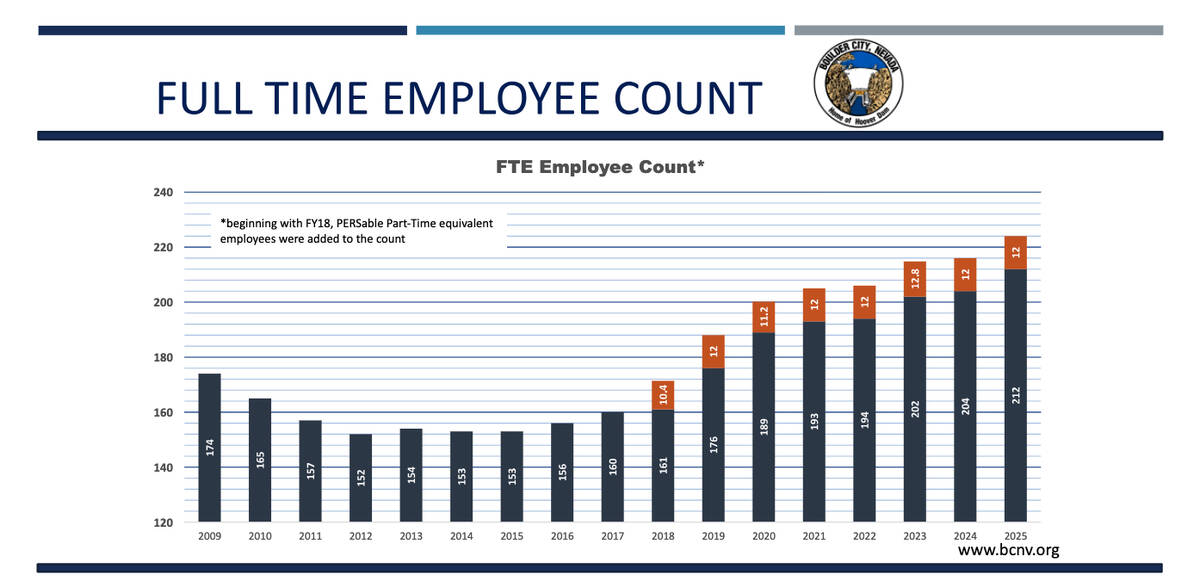
If all positions are approved, it would represent a more than 25% increase in the number of full-time city employees in a period covering seven budget years. After staying pretty consistent through most of the decade starting in 2010 at 150-160 full-time staff members, the number started to increase rapidly in 2019. The eight additional positions being sought would bring the full-time head count to 212, which would represent a 32% increase since 2018.
The recommended additional positions include three firefighters, two police dispatchers, an aquatics facilities specialist, a “floating” administrative position within city hall and an apprentice lineman position working in the utilities department.
All of the requested new positions are funded for only part of fiscal year 2025. This is because the positions would not be filled, for the most part, until the fiscal year is half over.
“The idea of a partial year is to see cost savings in the first year. However, years two and beyond would be at the full year amount. The partial year is a one-time savings,” said Finance Director Cynthis Sneed in an email.
Heads of individual departments were on hand to advocate and answer questions, starting with Acting Fire Chief Greg Chesser.
According to a memo Chesser provided to the council, the Boulder City Fire Department’s current staffing model of seven firefighters on duty at any given time can often mean that the department does not meet national standards.
That situation is exacerbated if a firefighter or paramedic is out on sick leave or vacation.
Historically, the department has relied on a combination of reserve firefighters and mandatory overtime to cover in those situations. But the department has not been able to hang on to reserve personnel “due to the extensive full-time hiring occurring” in fire departments in the Las Vegas metro area.
People interested in a career as a firefighter would go through an academy put on by BCFD and then become reserves. The reserve firefighter pool could be tapped when a full-time member of the department was on vacation or leave, which helped to lower overtime costs. But the last fire academy started with 10 graduates and is now down to just one still in reserve as nine have been hired by other departments for full-time positions. As a result, Chesser wrote, the department will cease hosting reserve fire academies, citing a cost of $25-30,000 for each 16-week session in overtime costs for instructors.
Firefighters generally work a 48/96 schedule in which they are on duty for 48 hours and then off for 96 hours. The current shortage of staff means that they are regularly required to work mandatory overtime resulting in working up to 72 hours straight.
While the total cost in salary and benefits for three additional firefighters (two of whom would also be paramedics) would be almost half a million dollars, savings in overtime expenses would drop that to $177,671 in the upcoming fiscal year.
The lack of staff and loss of part-time employees to other departments offering full-time positions was echoed by Police Chief Tim Shea in his memo to the council supporting a request for two additional dispatchers.
Shea noted that the current staffing situation can often mean that there is only one dispatcher on duty for a 12-hour shift, leaving them unable to leave their posts for breaks, which leads to burnout and issues with retention. He noted in the memo that multiple times in the past several years, a newly-hired dispatcher found the job so overwhelming that they resigned before even finishing training.
The two requested positions are not envisioned as being budgeted for the entire fiscal year. One position would be funded for six months and a second for three months. Costs in the first year would be $80,000 and would increase to $231,000 in fiscal year 2026.
The requested addition to the city’s aquatics staff was described by Parks and Recreation Director Julie Calloway as a “proactive” step and it assumes that a new facility will be funded via the sale of Tract 350 and a ballot proposal in November. In her memo she wrote that adding an aquatics facilities specialist during the design and construction phases of the proposed new pool will “lay the foundation for success.”
The cost for the coming fiscal year would be about $40,000 with the requested position being filled halfway through the fiscal year. Costs for the position in FY 2026 would double to more than $80,000. Calloway noted that once the new facility is built —if approved and fully funded — there would be requirements for additional staff.
At the city-owned electric utility, director Joseph Stubitz reports that the city currently uses a third-party company when they need additional lineworker services at a cost of almost $120 per hour. He also noted that there are several current lineworkers who will be eligible for retirement in the next ten years which could increase the need for outside services.
He wrote that the city currently spends about $900,000 annually for lineworker services via third-party companies.
His recommendation is to establish a lineworker apprentice position in which the city would pay for the cost of schooling and getting the apprentice a commercial driver’s license. Stubitz noted that the approach comes with some risk as attracting qualified candidates can be difficult and an apprentice may not succeed in moving beyond being a journeyman. However, the annual costs for a full-time apprentice is about 25% less than the cost of using a third-party provider just 20 hours per week.
The final requested staff addition is a “floater” in city hall who would both cover clerical and administrative holes in coverage caused by employees being on vacation or extended leaves of absence as well as addressing a large backlog of documents that need to be digitized. Example: the Community Development Department has explored using temporary staff provided by a third-party agency to address a two- to three-year backlog of physical records that need to be digitized but have found that they have difficulty both in getting temps and in guaranteeing work standards.
The cost to establish the floating position would be $49,000 in fiscal year 2025 with the position not being filled until the year is half over.
The cost in FY 2026 would increase to $106,000 including salary and benefits.
The council voted unanimously to direct city staff to move forward with budget plans, including the new positions. There will be a public hearing on the budget for fiscal year 2025 before it is officially adopted no later than May 28.