City opens process for energy storage facility




In a bit of a twist on the old saying, the preview of a potentially big development for Boulder City’s future in terms of both money and tech came packaged in a tiny, one-page bill introduced to the council last week.
While the time spent in the meeting was minuscule, the impact is potentially more than $50 million. The action by the council was limited to the formal introduction of a bill to approve the lease of about 40 acres of land in the Eldorado Valley for a battery-based energy storage facility.
Actual consideration of the bill approving the lease agreement is scheduled for the July 11 meeting of the City Council.
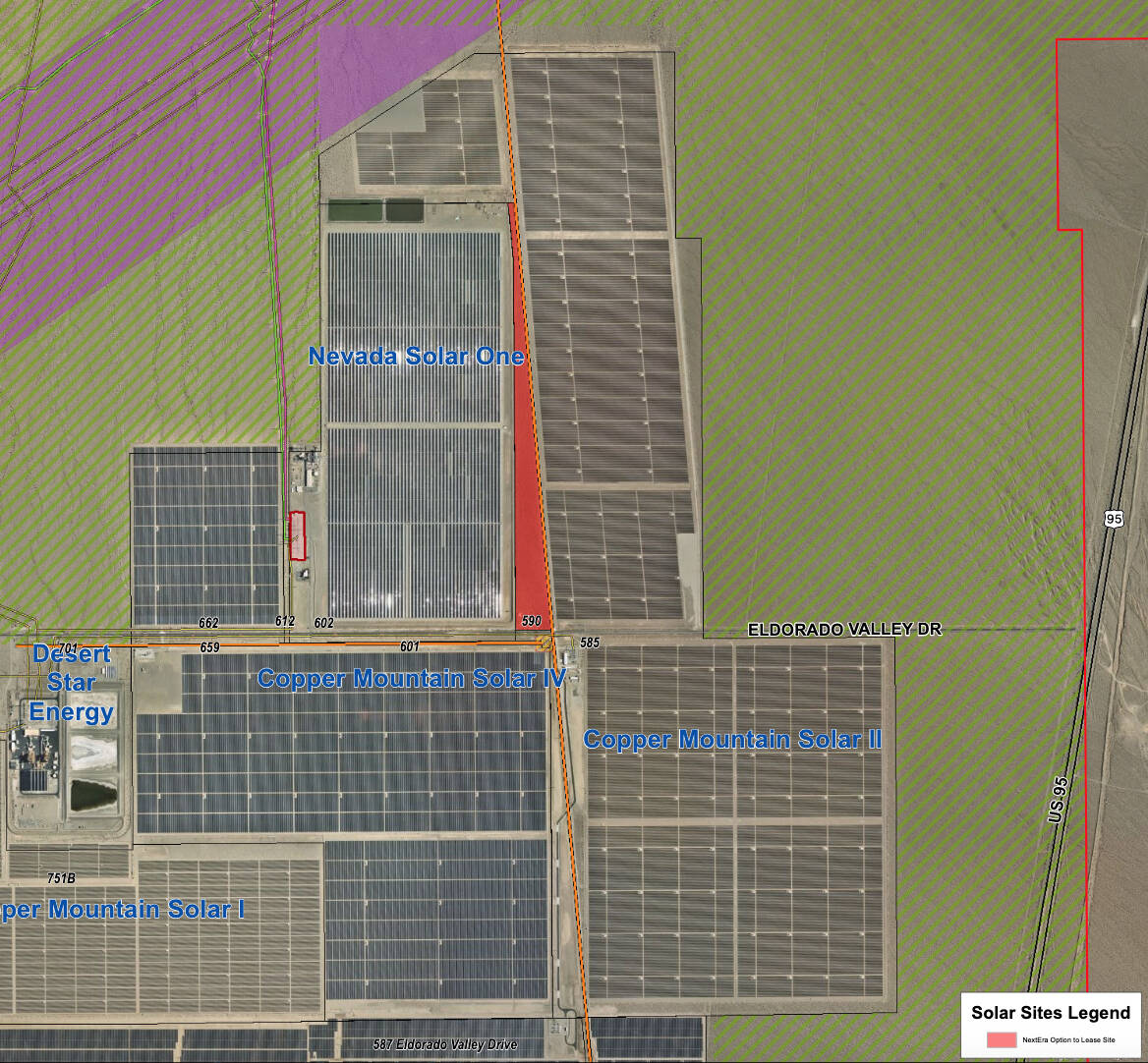
Plans call for the project to be built on a narrow wedge of land located between two existing fields of solar panels. When completed, the storage facility is projected to be able to supply 350 megawatts of power continuously for a period of four hours.
Putting that into more easily understood terms like, “how many homes would that power”, is less straightforward than one might think. Energy usage per household varies a lot by region and not all megawatts are created equal.
For example, a power plant generating a consistent power supply of a single megawatt is considered enough to power as many as 1,000 average homes. That number is lower in areas like the South and higher on the West Coast. Most of the difference can be chalked up to air-conditioner usage.
The key part of that equation is the word “consistent.” It means the ability to generate that megawatt of power 24 hours a day, 365 days a year regardless of variables such as weather or darkness. So a power plant run by coal, nuclear or natural gas can supply a consistent energy flow.
But renewables, including solar, are not consistent. A solar panel only produces energy when the sun is shining on it. The result is that, according to multiple major university studies, a single megawatt of solar generating capacity has far less potential, as little as 164 homes. Battery storage facilities such as the one being proposed on the outskirts of Boulder City are a way to increase the efficiency of solar power by storing excess energy produced when the sun is shining so that it can be used when the sun is not shining.
Under the terms of the proposed lease, the city would receive an initial payment of about a half-million dollars when the lease is signed. That would be followed by an annual fee of $200,000 while the project is under development. The lease terms limit the development period to no more than seven years.
Once the project is completed and online, the base rent triples to $600,000 per year. In addition, the city would receive an additional fee called annual storage capacity rent. This fee would be paid quarterly at a rate of $2,000 per megawatt of storage. So, if the facility is able to generate the proposed 350 megawatts of capacity, the city would stand to earn an additional $700,000 per year bringing the total income to about $1.3 million per year.
The lease that will be considered on July 11 is for a period of 40 years with an annual adjustment of 2% for both the base and storage capacity rent.
Contact reporter Bill Evans at wevans@bouldercityreview.com or at 702-586-9401.