Shine some light on the news
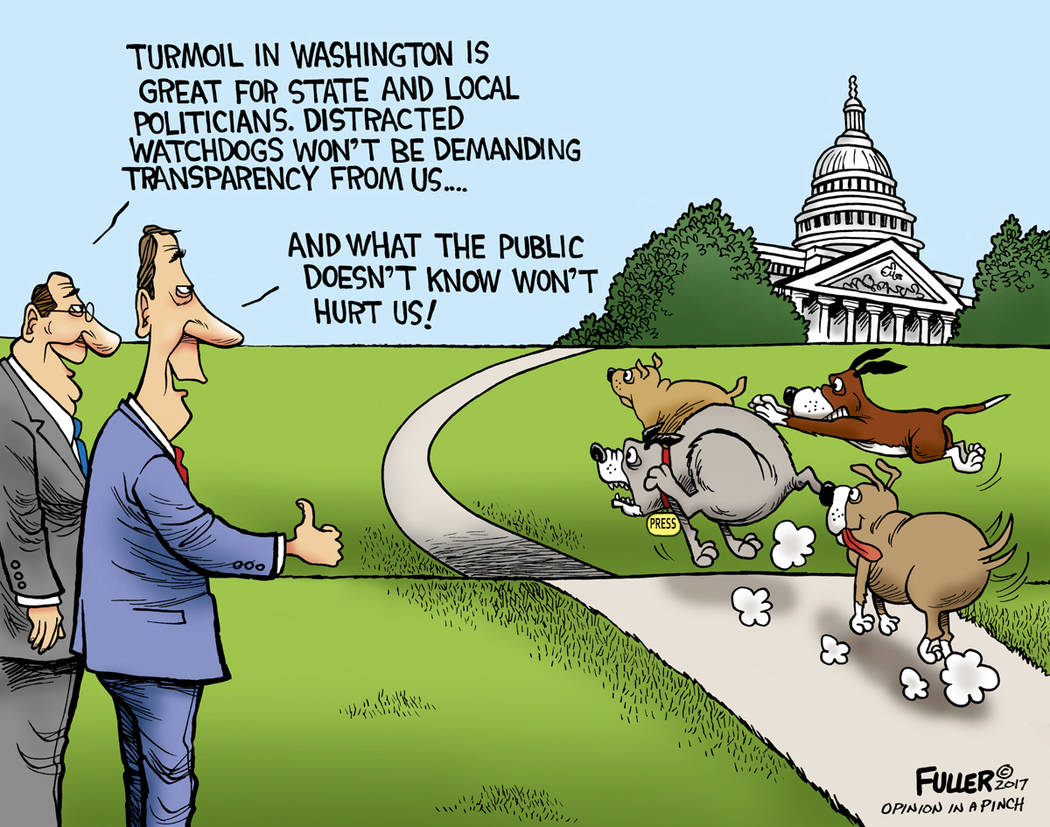


In the years I’ve been writing Sunshine Week columns, rarely have I turned around the lens to examine the responsibilities of the press in making sure our role in democracy is transparent and honest.
Usually I’m haranguing some government body or another about First Amendment issues, or complaining about a bill before the Nevada Legislature. There is no shortage of such topics this year, but it seems like an appropriate time to shine a little light on my own profession.
From the accusations of fake news to the rise of alternative facts, skepticism and mistrust are high. So let me offer a few suggestions to help us all regain trust in the press.
The foundation for these thoughts is the Society of Professional Journalists’ code of ethics. I encourage you to read the entire code to find out what journalists agree is a minimum set of standards for their work.
A great thing about journalists is that anybody can be one. There’s no government-issued license, no requirement for a college degree or specified course of training. It’s open to anybody who wants to inform others, and all you need is a newsletter or blog.
Of course, that also means we’re free to be dishonest, self-serving and incompetent. We have to prove ourselves every day with every story. All we have is the credibility we build with readers. That’s why the best ones do have training, experience and follow an ethical code.
Separate news from opinion
The line has become hazy, when it should be black and white between straightforward news articles and editorials, columns and letters that are expressions of opinion.
Yes, there is a broad spectrum of writing under journalism — analysis, background, first-person reporting, and so on. We can do a better job of providing context to readers.
I realize some people see bias in everything they read, and I won’t dispute the underlying prejudice that any writer brings to his work. We’re human, you know.
But news articles are intended to be fair, accurate and thorough, and they go through a stricter editing process than opinion pieces. There are different standards and expectations.
So when I see the two intermingled, without any guidance to readers as to the distinction, it can confuse and diminish the publication’s credibility.
It’s like walking into a fine-dining restaurant and being handed a fast-food menu. You’ll feel deceived because of your expectations.
Stop relying on anonymous sources
The journalists’ code of ethics says, “Identify sources clearly. The public is entitled to as much information as possible to judge the reliability and motivations of sources.”
Currently, we’re seeing a steady stream of stories from major publications attributed to unnamed leaks. Often those stories are based on multiple sources, and have a higher level of confirmation than many people realize.
Still, the practice of using anonymous sources places the entire burden of credibility on the publication, rather than the sources. Readers are asked to take them on faith.
The SPJ code recommends reporters “consider sources’ motives before promising anonymity. Reserve anonymity for sources who may face danger, retribution or other harm, and have information that cannot be obtained elsewhere. Explain why anonymity was granted.”
Seek out a greater variety of viewpoints
This goes for reporters, but it’s also a good practice for readers.
There is no single, all-knowing source for news. Reporters are trained to seek opposing sides of a story to provide context and balance, but they sometimes fall into habits of turning to familiar sources. They can fall into their own echo chambers.
That’s also true of readers, who should show a willingness to venture beyond their comfort zones and challenge their own assumptions.
We’ll all learn something. And that, really, is the point of Sunshine Week.
Barry Smith, a former newspaper reporter and editor, is executive director of the Nevada Press Association.