Is it OK for me to build an addition onto my house?




Over the past week, city staff has been touting (via social media) new exterior design guidelines for properties in the Historic District. The guidelines were adopted by the Historic Preservation Commission back in May of this year.
It might seem to be the kind of decision for which a property owner would be able to research in terms of the discussion, the justifications and the process, especially considering that the guidelines that limit what a property owner can do with their property was adopted by a non-elected commission whose members were advised by by a third-party consultant. The commission members are appointed by the city council and, due to the degree of specialized knowledge needed, the commission is not advised by a member of city staff. Instead, they use an outside consultant hired by the city.
But it would seem those are not rational assumptions.
The city has not issued anything explaining why interested parties can’t even go back to the appropriate meeting and watch the video. Owning to “technical difficulties,” only the first nine minutes of the May 22 meeting where the guidelines were adopted are available online.
Then, maybe the official minutes from the meeting? Also a no-go. The minutes for the meeting are scant. The only information to be gleaned is that the city’s consultant, Courtney Mooney, provided an overview and then made herself available for questions. There were none.
The commission then proceeded to vote unanimously to accept the guidelines.
So what is available to interested observers? The actual guidelines, which exist as a 78-page PDF document, are on the city’s website.
There is far too much in that document to really go into detail here. But the highlights include: Regardless of whether the structure is still exactly as it was during the “period of significance” (1931-1945) — i.e., a “contributing property” — or if it has already been remodeled or added onto beyond recognition — a “non-contributing property” — the guidelines apply equally because “Designated historic districts are significant as a collective whole and must be protected in their entirety.”
The guidelines for non-contributing properties were not developed locally and were, instead, taken from federal guidelines published by the National Park Service.
A property’s historic function has to be evident even if the property is no longer being used for the same purpose.
However, regardless of the previous guidance, new construction cannot attempt to replicate historic building or features existing elsewhere in the property in order to “avoid creating a false sense of history.”
Examples include: An addition to a historic home at the rear of the property that can’t be seen from the street is probably OK.
Adding a second story to the same house is probably not OK.
Adding new “infill” structures to a multi-building property set around an open central courtyard, also not OK.
Using construction material other than screening to enclose a screened-in front porch is also not OK.
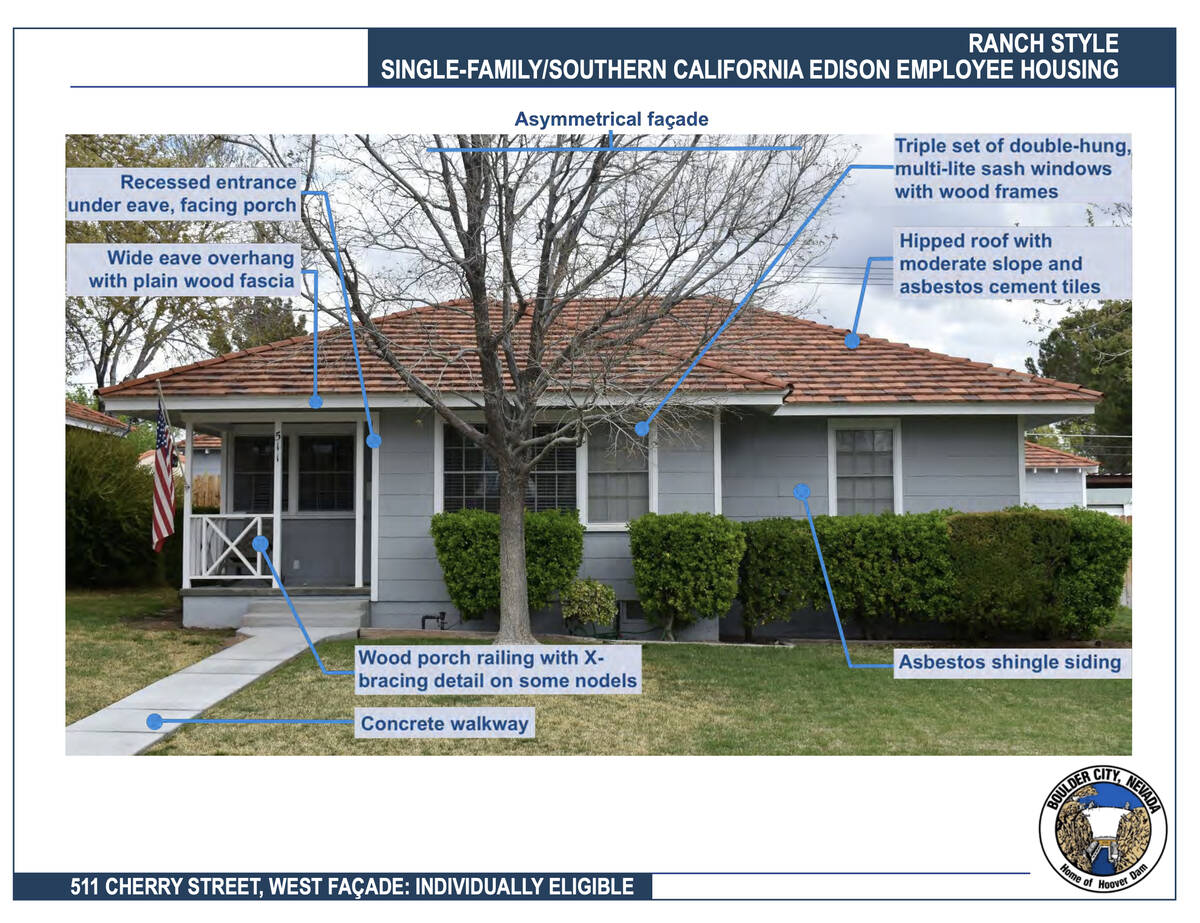
The document includes descriptions of many different styles of buildings — all considered historically significant — along with lists of addresses of buildings of that style that are considered as “contributing” within the Historic District as well as marked-up photos of example properties with various building details labeled.
The city of Boulder City strongly encourages contacting the Community Development Department prior to finalizing a design for a project on a historic property, whether it is considered contributing or non-contributing. A representative of the department is available to meet with the property owner or owner’s representative to review proposed designs and can assist the applicant with meeting the city’s compliance goals and objectives.