Dropping water level exacts costs
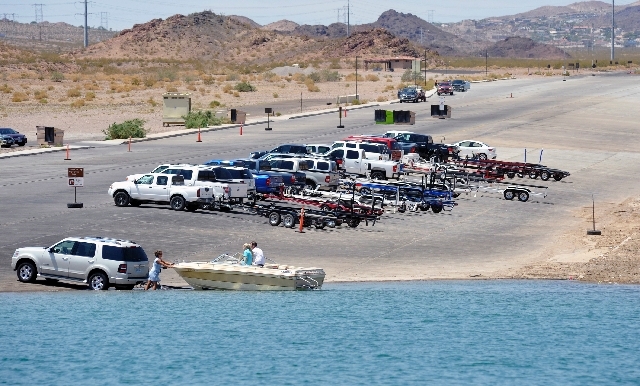




A dropping Lake Mead water level is forcing marina operators and the National Park Service to spend large amounts of money maintaining the lake’s accessibility.
According to an announcement Friday from the Bureau of Reclamation, Lake Mead’s water level will likely drop more than 20 feet by September 2014, with a slight possibility of it hitting an all-time low. The decrease is in part because of a 14-year drought, and the amount of water that is released from Lake Powell to Lake Mead being cut in the coming year.
As the water level drops and the shoreline recedes, docks, launch ramps and other infrastructure will need to be adjusted.
For every 20 feet the lake drops, approximately 600 feet of shoreline are lost, resulting in an expensive game of catch-up, Park Service spokes woman Christie Vanover said.
“When we drop 20 feet, that can cost (the Park Service) $6 million to $8 million,” she said.
The necessary work includes launch ramp and road extensions, the creation of more parking space, the relocation of restrooms, and other adjustments, Vanover said. She said all eight of the launch ramps operated by the Park Service will need to be extended, and the Park Service and bureau would be meeting this week to further discuss what work might be needed.
The cost of the improvements is not expected to be passed on to visitors through increased fees, but “It is a challenge with regard to our current budget system,” Vanover said.
The dropping water level also costs businesses such as Forever Resorts, which operates Callville Bay Resort & Marina and Temple Bar Marina.
“Over the last 10 years we’ve spent hundreds of thousands of dollars keeping our marinas floating,” Forever Resorts Regional Vice President Rod Taylor said.
Temple Bar Marina requires a move about every two weeks because its flat landscape makes for a greater recession of shoreline, Taylor said.
“You drop 1 foot and you loose 10 feet of beach,” he said.
Callville Bay Marina requires less frequent moves, but there will likely be a move in the next week or so, Taylor said.
When a marina is moved, it’s not as simple as merely scooting it away from the shoreline because electric and sewer utilities also have to be extended, Taylor said.
“You can only go so far with electricity and wire then you got to start adding transformers,” he said. “There’s all sorts of costs involved.”
Adding insult to injury, visitor numbers at Lake Mead National Recreation Area have been in a slump in recent years. Beginning in 2009, the park’s annual 7.8 million to 8.2 million visitors started to decrease, hitting a low of 6.6 million visitors in 2011, Vanover said.
The visitor shortage has resulted in Forever Resorts having to reduce its workforce by more than 100 people in the past few years, Taylor said.
“We went from 275 employees in 2010, to 150 employees,” he said. “There are jobs that are being lost with the decline in the visitation.”
Taylor said he thinks negative public perception of a decreasing water level is equally responsible as the economic recession for the low visitor count.
“Typically, the media will show that the lake is turning into a mud hole and the lake is going dry, and people will read that in Southern California, and 85 percent of our business comes from Southern California,” Taylor said.
It’s a frustrating situation, because both Taylor and Vanover claim the decreasing water level does not affect one’s ability to recreate on the lake. Even with next year’s projected decrease, Lake Mead will still by far be the largest reservoir in the United States, Vanover said.
Stuart Litjens, owner of Boulder City- and Henderson-based Boulder Boats, said the decreasing water level does not affect boating whatsoever.
“It just varies, it fluctuates. You’re just exposed to different obstacles and the lake is always changing,” he said. “For us it’s a nonissue.”
Litjens said business at Boulder Boats has been increasing since opening in 2004.
The most-recent figures, from 2011, indicate that Lake Mead tourism contributes $246 million annually to Southern Nevada’s economy, supporting 3,000 jobs, Vanover said.
“We’re willing to invest the money and were committed to keeping access available, but we need the public to know there’s still water out there from a recreation standpoint,” she said.