‘Nevadans can’t drink tax dollars’: Voters uneasy on data centers, water ahead of election
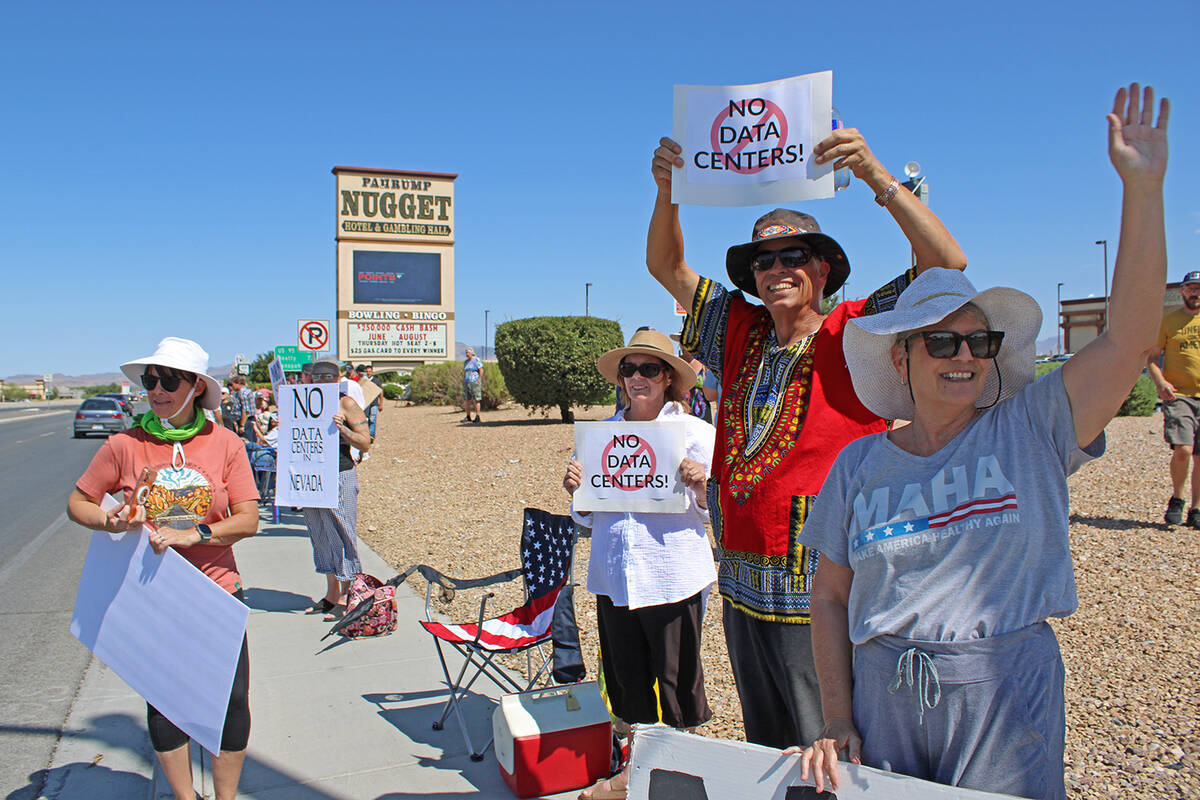




Most Nevadans are opposed to the development of data centers, and an even greater share are worried about growth and the state’s scarce water resources ahead of the midterm elections, according to a new statewide poll.
The survey of 800 registered voters in Nevada — conducted Sept. 22-26 by the nonpartisan, Phoenix-based polling firm Noble Predictive Insights — represents a growing chorus of voters who are calling on elected officials, both local and statewide, to create guardrails for data centers. The poll has a margin of error of plus or minus 3.46 percentage points.
These warehouses largely owned by tech billionaires house IT infrastructure that stores data and powers online applications or services, including artificial intelligence. Depending on the way they are designed, data centers can require massive amounts of power and water to function, stoking fears about noise, air pollution and more.
Growth and its impact on the state’s water supply has been a hot-button issue for decades in Nevada. That has come to a head as the Southern Nevada Water Authority sues the federal government over its assertion that it can force reductions of the state’s share of Colorado River water by up to 71 percent.
“It doesn’t matter how much additional tax revenue data centers and new residents bring in,” said Mike Noble, the polling firm’s CEO, in a statement. “Nevadans can’t drink tax dollars if there isn’t enough water to go around.”
Water, data centers not always linked
Poll results reveal that 83 percent of Nevadans are concerned about growth and its impact on the state’s water supply. In an interview, Noble said the water question was not presented in the context of data centers.
Asked if they support the construction of additional large data centers in the state, 57 percent said they oppose it, 34 percent said they support it and 9 percent were unsure.
Tray Abney, a spokesman for the pro-industry Nevada Data Center Alliance, said in an interview that he acknowledges the data center industry has a major public relations issue. He contends, however, that properly sited data centers are a boon to county and state economies, especially rural ones that struggle to fund public services.
“If you’re going to have industrial buildings in your community, these are probably the cleanest, most tax-producing industrial buildings you could have,” Abney said. “There needs to be an education campaign, not just of our public officials, but of the community at large.”
In Clark County, where the majority of the poll respondents live, water managers have said that new data centers do not represent a water issue. That’s because of the water authority’s ban on evaporative cooling, which forces tech developers to seek either a closed-loop or air-cooled system for data centers.
The water authority updates its resource plan annually, revealing projections for how long permanent, temporary and future water supplies can sustain the Las Vegas Valley at its growth rate. Officials have told the Las Vegas Review-Journal that the agency was created to be “growth-agnostic,” allowing growth and responsible water management to coincide.
Elsewhere in Nevada, the water story is different. No such evaporative cooling ban currently exists statewide, and the Nevada Legislature is expected to revisit data center rules in 2027. Water availability varies in other corners of Nevada, with more than half of the state’s groundwater basins considered overcommitted in terms of water rights.
Data center laws to come in 2027?
Olivia Tanager, executive director of the Sierra Club Toiyabe chapter, said the poll is proof that voters across the political spectrum are rightfully worried about data centers and water resources.
The poll showed 45 percent of Republicans, 56 percent of nonpartisan voters and 70 percent of Democrats said they oppose hyperscale data center development. Based on the polling numbers, Noble said candidates should take a middle-of-the-road approach to data centers no matter their party affiliation.
“That gulf between reality and perception is just massive,” Noble said. “Nevadans could really take advantage of a new age gold rush. Because that’s what it is.”
Both Tanager and Abney said they expect data centers to be a key issue in the 2027 Nevada legislative session, though what happens in November’s election may dictate the specific conversations lawmakers have. One bill that will be considered proposes a full repeal of data center tax breaks and a statewide pause.
Gov. Joe Lombardo, the Republican incumbent, has issued an executive order directing staff to create a pledge for tech companies to sign that will create environmental standards they must abide by if they want to benefit from tax breaks.
Attorney General Aaron Ford, running for governor as a Democrat, has proposed a full pause and audit of data center tax breaks. Both candidates have expressed concerns about power, water and more.
“What happens in 2027 is predicated on what happens in November with the election,” said Tanager, whose organization has supported Ford’s data center plan. “We’re all waiting with bated breath to see how that shakes out.”
Contact Alan Halaly at ahalaly@review journal.com. Follow @AlanHalaly on X.