War of words flares in Arizona over Lake Mead water
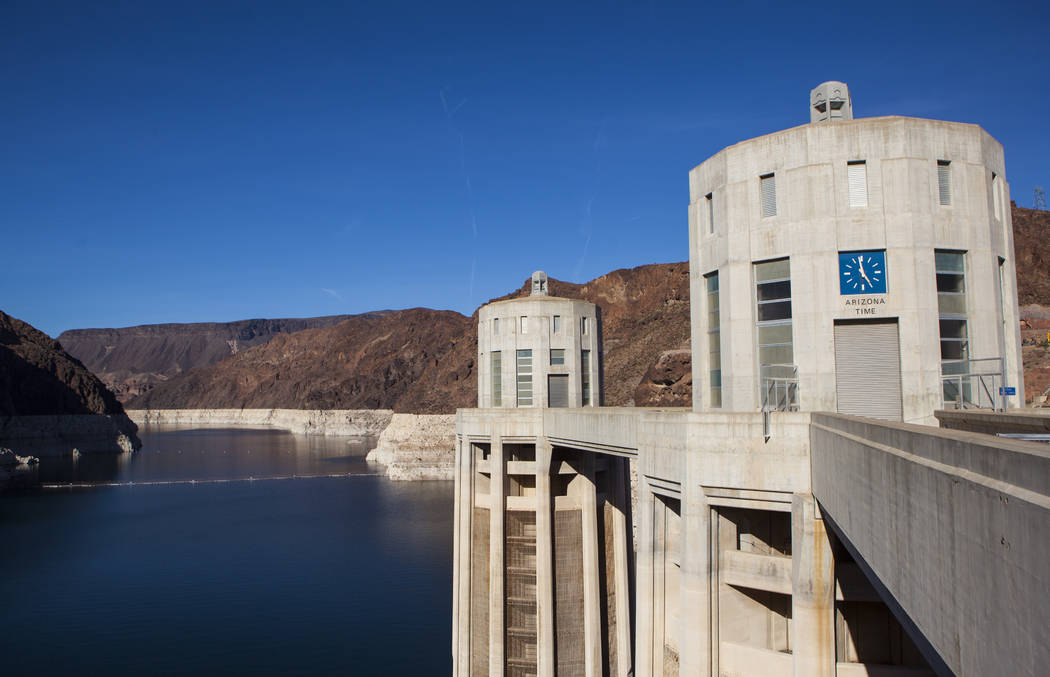





Officials in Arizona have reached an impasse on a multistate agreement aimed at storing more Colorado River water in Lake Mead, but Southern Nevada Water Authority chief John Entsminger said he is confident the deal will still get done.
Since 2015, Nevada, California and Arizona have been negotiating a drought contingency plan to keep Lake Mead from shrinking enough to trigger a first-ever federal shortage declaration and force Nevada and Arizona to cut their use of river water.
Despite recent signs of discord, Entsminger said the states are still “holding firm” to an agreement in principle under which Nevada, Arizona and, eventually, California would voluntarily reduce use and leave water in Lake Mead when the surface of the reservoir falls to certain trigger points.
He said he expects the plan to be finalized late this year or early next year, once the “diverse constituencies” of water users in Arizona and California figure out how the voluntary cuts will be made in each state.
Apparently, Arizona has more work to do.
Three of the state’s top water managers have staked out opposing positions on the contingency plan in dueling opinion pieces published in the Arizona Republic.
Board members Alexandra Arboleda and Mark Taylor from the Central Arizona Water Conservation District got things started on April 21 when they floated an alternate plan in the state’s largest newspaper to artificially keep Lake Mead just above the trigger point for a shortage, a move they said would force the release of more water from Lake Powell upstream while lessening the need for water reductions in Arizona.
‘It doesn’t hold water’
Tom Buschatzke, director of the Arizona Department of Water Resources, responded April 30 with an op-ed of his own dismissing Arboleda and Taylor’s idea as a “risky gambit” that seeks to game the system.
“It doesn’t hold water. I won’t support it. It’s that simple,” he wrote.
The unusual public exchange hints at a long-simmering power struggle between Buschatzke’s agency and the Central Arizona Water Conservation District, which operates and maintains the canals that deliver Colorado River water to Phoenix and Tucson.
Buschatzke downplayed the dispute in a follow-up statement May 3, noting that progress is being made on “an intra-Arizona plan.”
“It is conceivable an agreement among Arizona water users could occur later this year,” he said. “However, it is likely the Arizona Legislature will not be in session then. Thus, the most likely time frame for (contingency plan) approval will be early next year.”
Lake Mead levels
Luckily, Entsminger said, an unusually wet winter in the mountains that feed the Colorado has bought everyone more time. The additional snowmelt is expected to boost Lake Mead and delay a shortage declaration for at least another year.
Entsminger just hopes the temporary respite doesn’t cause water officials to lose the sense of urgency that has carried the talks this far.
“It’s human nature to take your foot off the gas when it seems like you have more time,” he said.
The Colorado supplies water and power to 30 million people in seven Western states and irrigates $1.5 billion of crops a year. The Las Vegas Valley draws 90 percent of its drinking water from the Colorado by way of Lake Mead, which has seen its surface drop by roughly 130 feet since drought descended on the river in 2000.
Contact Henry Brean at hbrean@reviewjournal.com or 702-383-0350. Follow @refriedbrean on Twitter.
Transition pauses water talks with Mexico
Progress also has stalled — this time for bureaucratic reasons — on treaty talks between the U.S. and Mexico over how to manage the Colorado River across the international boundary.
Southern Nevada Water Authority General Manager John Entsminger said discussions are in a “holding pattern” until President Donald Trump fills several key Interior Department positions.
Under an existing treaty amendment, set to expire on Dec. 31, Mexico can store some of its annual Colorado River allotment in Lake Mead, providing a boost to the reservoir.
The two countries are close to a new pact that would spell out Mexico’s share of cuts in the event of a federal shortage declaration on the river. The latest amendment to the 1944 water treaty would also free Mexico to continue storing some of its river allotment in Lake Mead and allow U.S. water agencies to invest in infrastructure improvements south of the border in exchange for a portion of the saved water.