Lake Mead’s slow demise just sped up in latest federal study
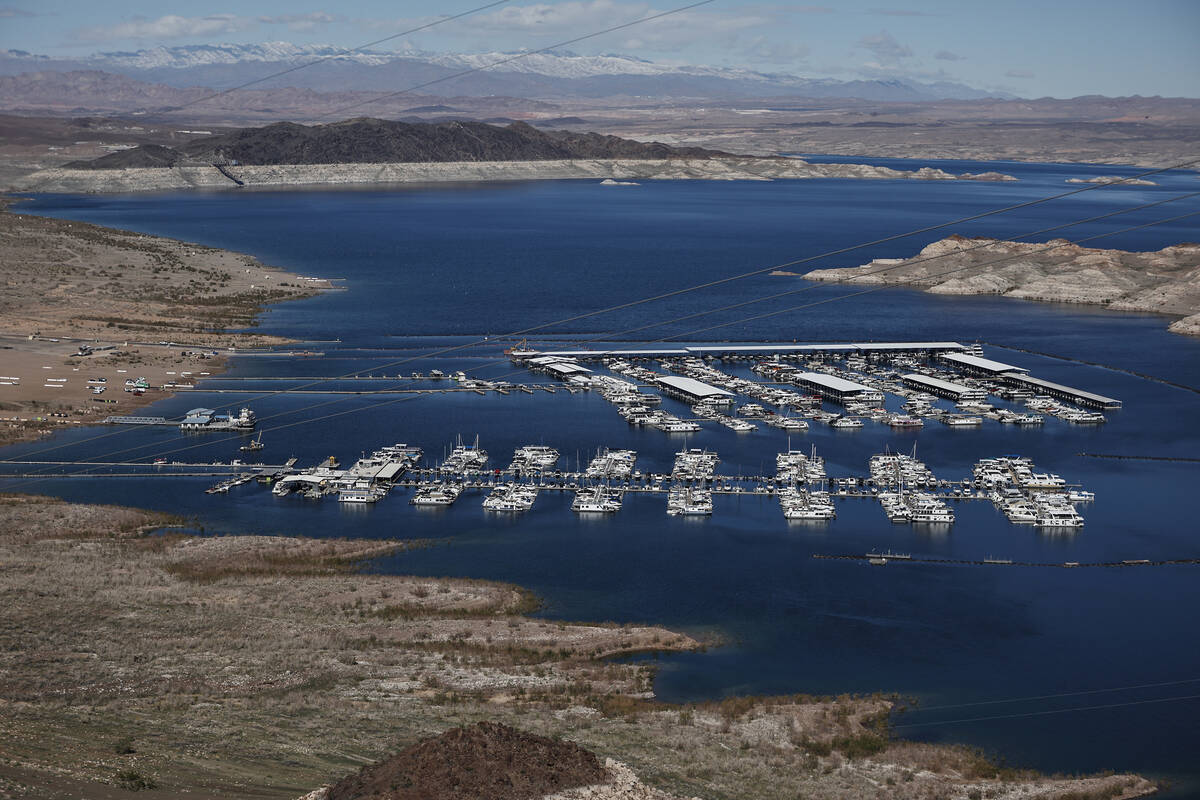




The reservoir that serves as Southern Nevada’s main water supply is headed for an even more painful decline than thought due to historic drought and recent water management decisions, according to federal forecasters.
Lake Mead could plummet to 1,015.77 feet above sea level in July 2027, far below any level seen since the reservoir was filled in the late 1930s. After that, though projections are less reliable the further into the future they go, water managers expect only a small uptick until another record low is set at 1,011.74 feet in May 2028.
That low level is nearly 29 feet below the reservoir’s all-time low set in 2022. On Monday, the reservoir was almost 29 percent full at about 1,047 feet above sea level.
“It is very grim,” said Sarah Porter, director of the Kyl Center for Water Policy at Arizona State University. “We didn’t expect good news. But the study underscores, again, that we’re in a really bad place.”
Monday’s study is a noticeable departure from what scientists had predicted. Last month’s two-year study from the U.S. Bureau of Reclamation had the most probable lowest level at 1020.76 feet for July 2027.
Eric Kuhn, retired general manager of the Colorado River Water Conservation District in Colorado, said in an interview that it’s a reflection of water managers taking a somewhat different approach.
“They’ve reduced it significantly, reflecting what I’m thinking is a more conservative approach that considers what happens if next year is drier,” Kuhn said.
The news comes months after the Bureau of Reclamation’s emergency decision to prop up Lake Powell by moving water in from an upstream reservoir and reducing flows into Lake Mead. Current levels at Lake Mead should already reflect the change, Kuhn said.
Below 1,035 feet in elevation at Lake Mead, hydropower generation at Hoover Dam is significantly reduced.
A recently freed-up batch of $52 million in federal funds is going toward new wide-head turbines that can function at lower levels, however.
Unprecedented territory
Within every margin of error, Lake Mead is approaching unprecedented territory. But it’s not an immediate cause for alarm just yet for the livelihood of Southern Nevada or the some 25 million people who rely on the reservoir.
Late last month, a group of top Colorado River experts, including Kuhn, warned that the larger basin is one dry winter away from what they called “system crash.” The newest projection shows Lake Mead a few inches closer to that reality.
After that point — 3,500 feet in elevation at Lake Powell and 975 feet at Lake Mead — the two reservoirs become effectively useless for storing extra water due to infrastructure constraints that mean anything below those elevations isn’t considered realistically accessible.
Kuhn notes that even under the worst-case scenario for Lake Mead forecast on Monday, it still has a ways to go before reaching 895 feet in elevation, a so-called “dead pool” that would mean Lake Mead could no longer send any water downstream.
“There’s a cushion,” Kuhn said, adding that even in the most conservative estimates, Lake Mead is “still well above its dead pool. But it doesn’t look good.”
The worst snow season on record and the decline of the nation’s two biggest reservoirs are happening as the seven Colorado River states brace for a new short-term agreement for how to share mandatory water cutbacks.
State officials have failed over multiple years to come to an agreement, and the Trump administration will impose one instead, which could lead to a legal battle at the U.S. Supreme Court.
Porter, of Arizona State University, said the most pronounced effects of a system crash will be toward the agricultural sectors of California and Arizona, which produce the lion’s share of the nation’s winter vegetables.
“Cities have backup plans of falling back on stored groundwater that can help immediately when the river gets really low,” Porter said. “I think the real pain, potentially, could be going to agriculture.”
‘We can’t conserve enough’
Southern Nevada, one of the fastest-growing regions in the nation, has robust plans for its water supply that take into account different potential scenarios for upcoming winters.
Water managers do not anticipate slowing economic growth because of the water crisis, but they are doing what they can to ensure that building doesn’t push the valley’s use outside of the boundaries of its permanent, verifiable water supplies.
A water authority spokesman said last month that the agency has 10 years’ worth of water stored for Southern Nevada’s use between what it has in Lake Mead and water banked in groundwater aquifers in the Lower Colorado River Basin states of Nevada, California and Arizona.
In 2015, the Southern Nevada Water Authority completed construction on the third intake and low-level pumping station at Lake Mead, allowing regional water managers to access water at 875 feet of elevation, below the dead pool level.
Porter said Southern Nevada has been at the forefront of urban water conservation, but conservation in urban cities alone, such as ripping out grass or outlawing evaporative coolers, isn’t enough.
“The Lower Basin is pulling together and trying really hard to figure out what we can do to mitigate against catastrophic consequences,” Porter said. “But when there’s no water, there’s not much you can do. We can’t conserve enough to save this system.”
The Southern Nevada Water Authority has recently signed an agreement to explore a water transfer so Southern Nevada could benefit from a San Diego desalination plant.
In a statement, Rep. Dina Titus, D-Nev., said the study is proof of the rapid acceleration of drought.
“We must use every tool at our disposal to maintain our water supply — including the option of buying desalinated water in San Diego,” Titus said. “We also need to add and adopt sustainable growth actions rather than capriciously releasing land for development. We can no longer wait to take action.”
Contact Alan Halaly at ahalaly@reviewjournal.com. Follow @AlanHalaly on X.