Golden opportunity for local veteran
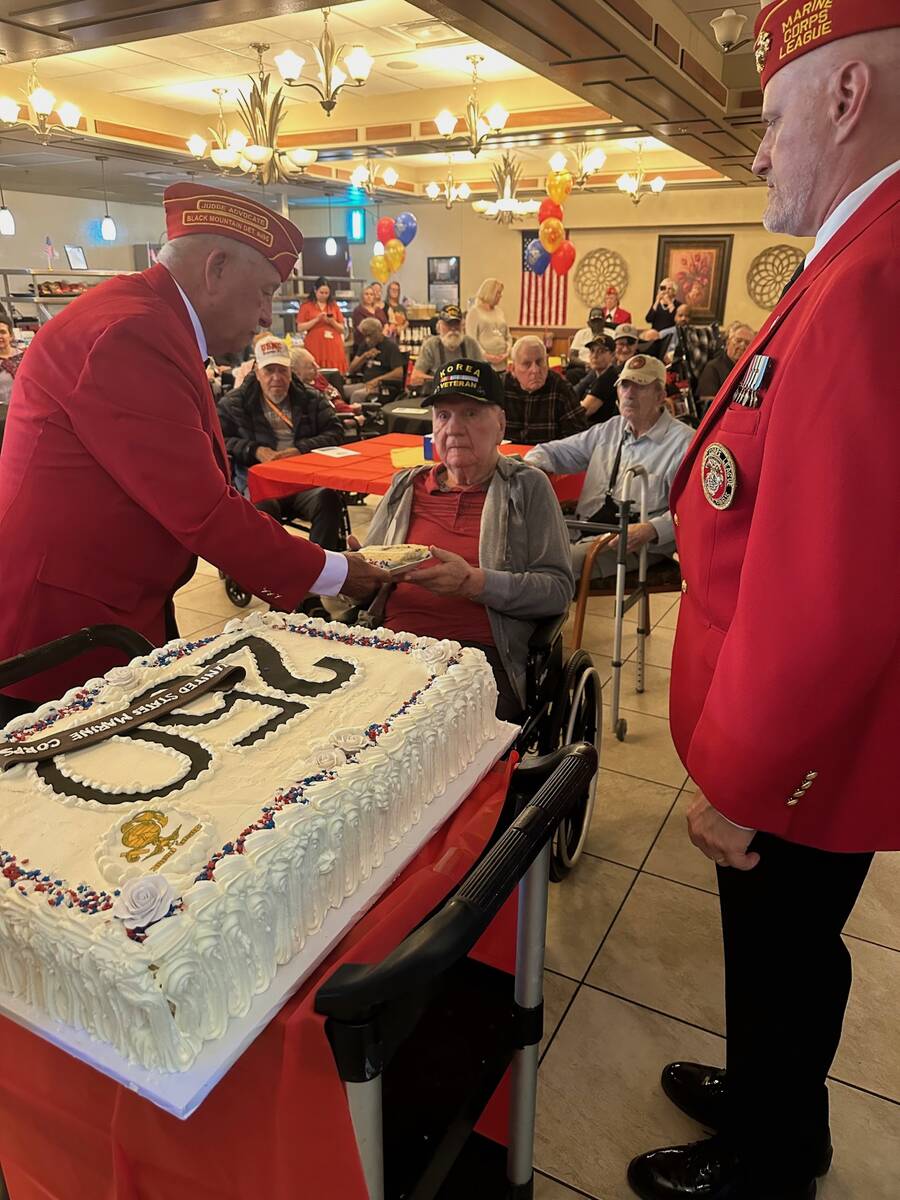
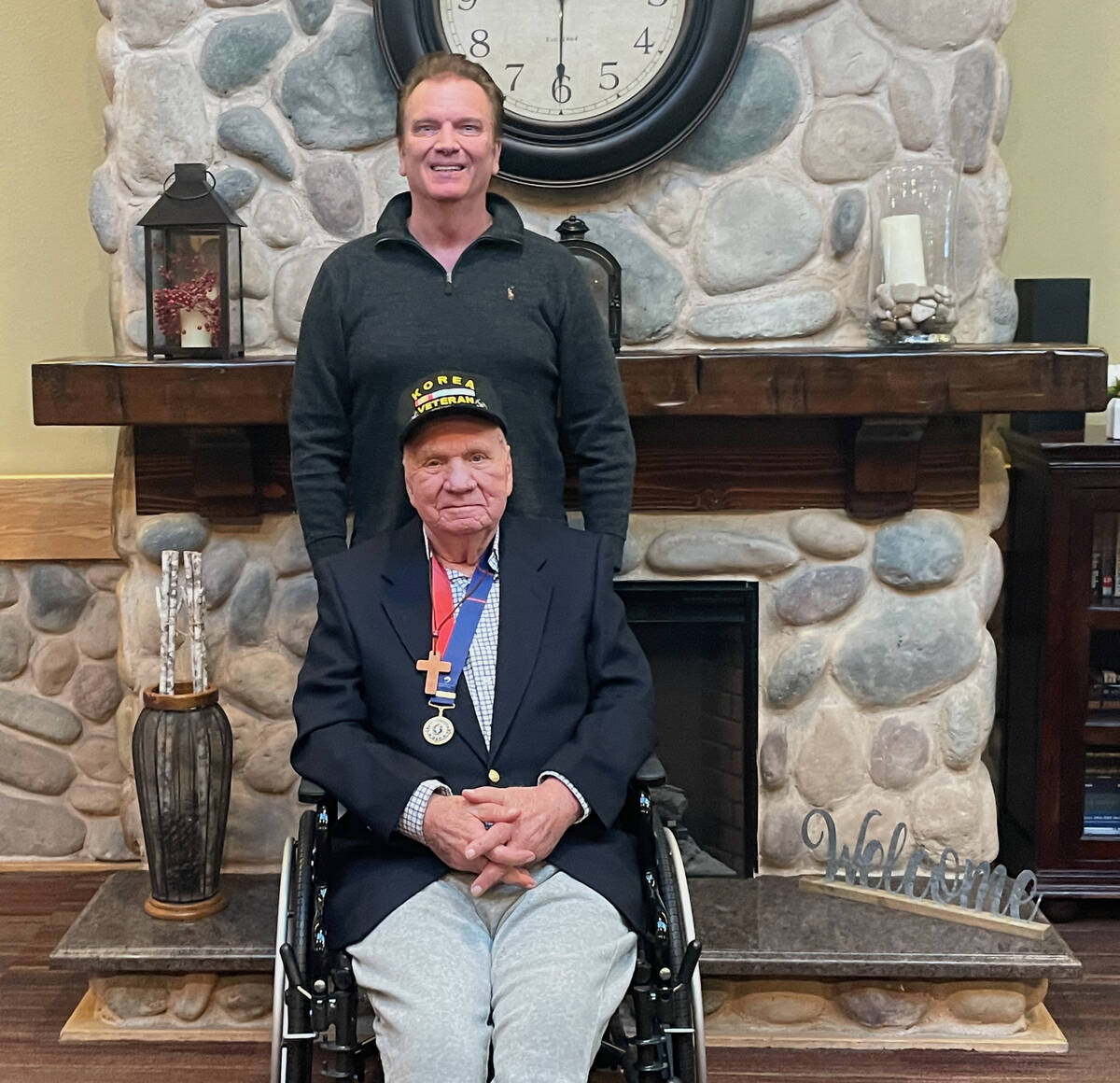




Editor’s note: For Veterans Day, a celebration of the 250th birthday of the Marine Corps took place at the Southern Nevada State Veterans Home in Boulder City. The event included cake served by members of the Marine Corps League that was sliced with a ceremonial sword. As the oldest Marine living at the home, Patrick Mervine was served the first slice.
About that gold…
Last week, Patrick Joseph Mervine, a new resident at the Southern Nevada State Veterans’ Home, was presented with the Medal of Honor by the government of South Korea for his service in the Korean War. The medal was presented on behalf of South Korea by Junghee Mun and Hansu Cheong.
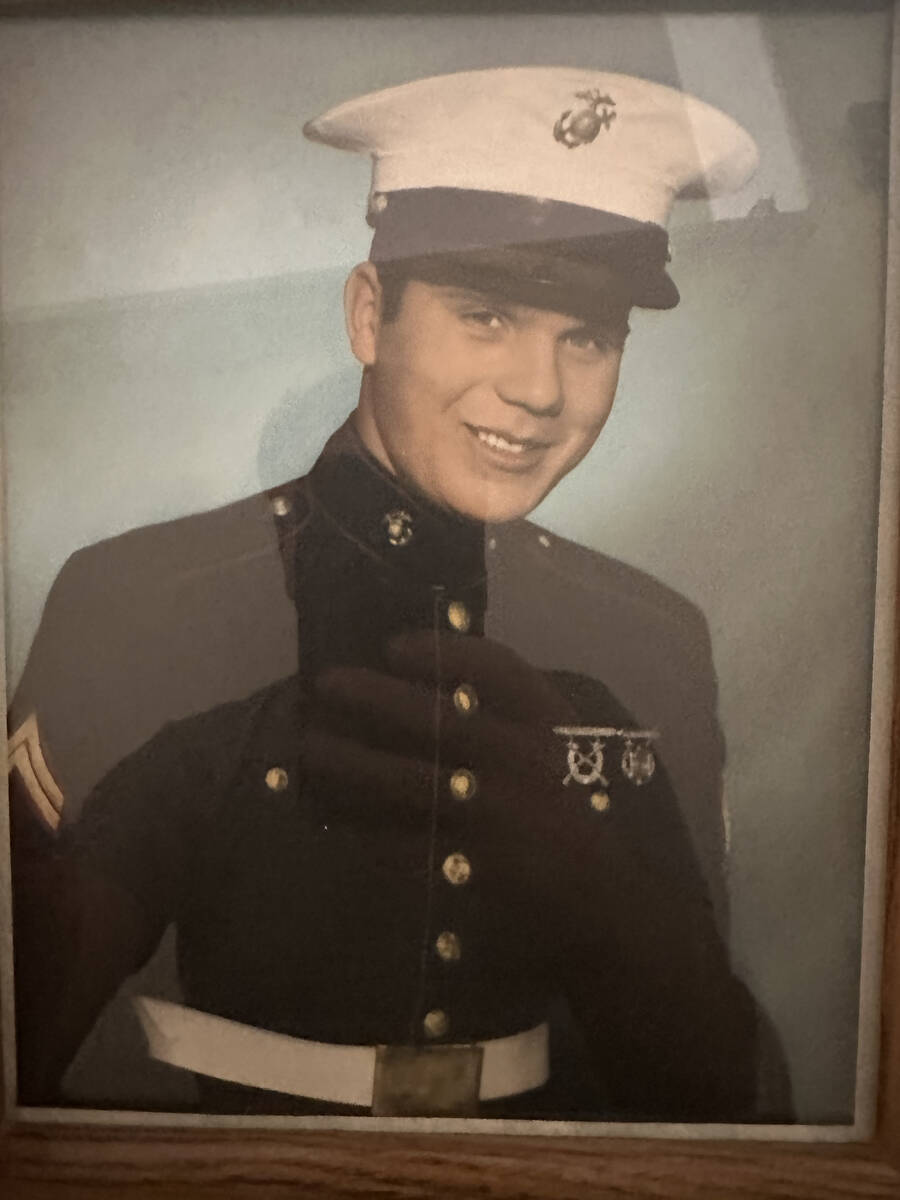
Mervine served in the Korean War for the most of the duration of the conflict from 1951-1953 and in the Marine Corps until 1955.
According to his eldest son (also named Patrick Mervine), his father, after boot camp at Camp Pendleton in Southern California served in the logistics corps driving a truck. “Dad drove a fuel tanker,” said the younger Mervine. “He got blown out of his truck once.”
When asked about the experience, the elder Mervine said he never really knew what happened. “I just remember a loud ‘bang’ and then nothing. I came to on the side of the road.”
An incident like that could have been his ticket home, but Mervine opted to stay and started driving again right away.
“Dad served until the end of the war in ‘53,” his son said. “He drove that truck all the way north to the border of Manchuria and then all the way back down to the 38th.”
Understanding that bit means breaking out the history book. Korea had, for 35 years before the end of World War II, been a colony of Japan. After the war, it was divided into two protectorates by the U.S. and the Soviet Union with the intention of it eventually being a unified nation. However, fighting between the two camps started pretty much immediately. In 1950, armed forces from the North invaded the South leading to the United Nations calling for other countries to assist. About 90% of the ostensibly U.N. troops were provided by the U.S., whose forces landed at Inchon in September of 1950. They fought all the way north to the border with China. At that point, the Chinese Army got involved and the U.S. troops were pushed back south. Fighting came to a stalemate around the area of the 38th Parallel, which now serves as the border between North Korea and South Korea.
According to his son, Mervine was born in Brooklyn, New York in 1933. He ran away from home at age 14 and made his way south to the Caribbean where he spent some time working on a banana boat before heading west to California. By the late 1940s, he was living in Riverside and began to race his hot rod up Market Street in that then small town. It was there where he met a Marine officer who encouraged him to enlist.
After the war, he became a teamster and worked as a driver hauling construction materials to what eventually became Disneyland. Asked if he got invited to the opening of the Happiest Place on Earth, Mervine retorted, “We were just truck drivers. We didn’t get invited to nothin’.”
After the Disney experience, he became a UAW worker at McDonald Douglas in Long Beach building airplanes. After that he became a steel worker in Fontana, Calif. at Kaiser Steel, which is where the Gold Story comes in.
“Dad was driving the big ‘Tonka Toy’ trucks, hauling slag,” said his son, at which point, dad interjected, “Let me tell you about the gold.”
The elder Mervine went on. “I worked the third shift, overnight. We hauled slag from the coke ovens out to the slag heap.”
Coke is a coal product used to fire the large, super hot ovens needed to melt and separate the iron ore that is used to make steel. The byproducts or leftovers — i.e., the stuff that is not iron — called “slag” is considered a waste product and historically has been dumped into barren areas known as “slag heaps.”
“Every few months, late at night, they would load a big ball into the back of my truck and we would drive out to the slag heap. I knew it was not regular slag because there were always sheriffs out there,” Mervine recounted. “That ball was so heavy that when we dumped it, the whole front end of my trick came up off the ground. They got dumped into these holes about 100 feet deep and then covered over with regular slag. Once I asked them what was so special about those balls and they told me it was gold.”
His son explained that the rock being melted down in the smelting process contained trace amounts of gold. And gold, being far heavier than most other metals, would naturally accumulate at the bottom of the coke ovens. “Every quarter, they would clean out the coke ovens and scrape the gold out of the bottom and form it into one big ball.”
Why would it get dumped into deep, unmarked holes? It sounds like the setup for a Hollywood heist movie. And no one knows for sure. The younger Mervine postulates that his dad was working at the Fontana Kaiser plant in the early- to mid-1970s and, between 1933 and 1974, it was illegal for U.S. citizens to own gold in raw form. “Plus, back then, gold was only worth maybe $30 an ounce. But at $2,700 an ounce today, one of those balls would probably be worth $1 billion.”
Is it true? No telling. But at the very least, it is a great story for the elder Mervine, now 91, to tell at the veterans’ home.