A step back in time



If someone is researching Boulder City’s history, chances are the majority of what they find will center around the building of Hoover Dam.
It makes sense because after all, without the construction of the dam nearly 90 years ago, more than likely Clean, Green Boulder City would not exist.
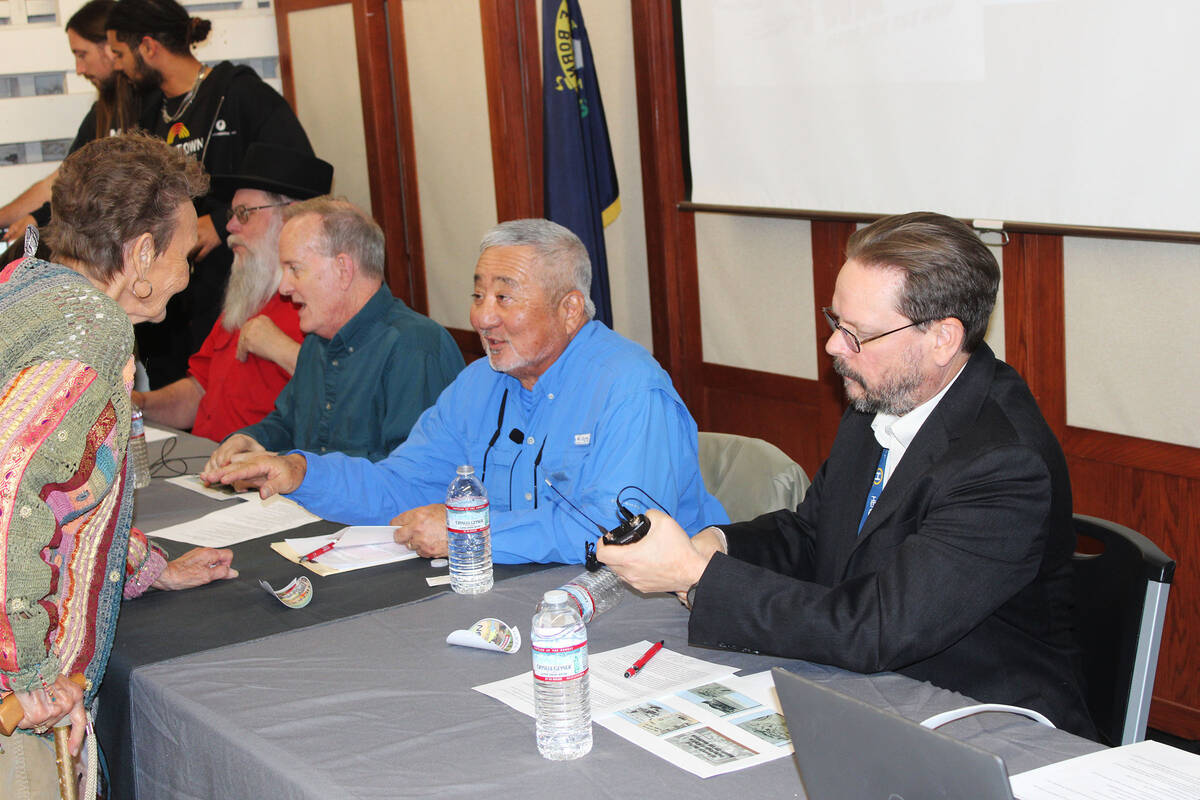
But there’s much more to the city’s past as shared during an event last Wednesday at the Clark County Museum in Henderson.
The standing-room-only crowd heard an hour’s-worth of history that centered on the city’s time during World War II. Two years ago, the National Park Service designated Boulder City and Henderson as American World War II heritage cities for their importance during the war.
A panel made up of local historians shared several stories about both Boulder City and the birth of Henderson during that time period.
On hand were Nathan Hill, archives and records manager with the city of Henderson and Alan Goya, former chairman of Boulder City’s Historic Preservation Commission. They were joined by Dennis McBride, a Boulder City native, author of many books and retired director of the Nevada State Museum and Mark Hall-Patton, historian, author and retired Clark County Museum administrator. Hall-Patton is also a familiar face for those fans of the TV show “Pawn Stars” thanks to his dozens of appearances.
“I’ve been trying to keep the stories alive from that era because they are really important and they changed America,” Goya said.
In 1935, according to McBride, once Hoover Dam had been finished, the population of Boulder City was around 7,000, about half of what it is today. But it continued to drop to less than 4,000 just a few years later.
“They originally thought they’d tear down the whole city as soon as the dam was finished,” he said. “A lot of people wanted to stay on in Boulder City because it was the only town they had known. They came to build the dam and by then they had families who didn’t want to leave.”
McBride said that in the late 1930s, the government was all but certain that the country would be involved in the war in one form or another. They were right.
Military installation
Many may not know that Boulder City was home to a small military installation during the war. Camp Williston was in place from 1941 to 1945 and was located in the area where Boulder City High School and the LDS church now sit.
Approximately 800 soldiers were brought in by train from Southern California. McBride said 500 of them were Black. But that didn’t go over well and most were not welcomed in most local businesses, he said, and were often harassed by police.
The camp was established to protect Boulder City and Hoover Dam, while also training soldiers to be military police.
During that time, McBride said it would be very difficult to stage a sneak attack on Boulder City, and primarily the dam, from the north, west or east but that the south (Eldorado Valley) was vulnerable. In order to protect the southern flank of Boulder City and the power lines that ran from the dam to Southern California, soldiers built tank traps, erected barbed-wire fences, trenches and fox holes all through the area in case Germany invaded. Ironically, all those protective measures are still in the desert.
“I remember going out there and wondering if it were a cattle ranch or something like that,” Goya said, eliciting a laugh from the audience.
After the war and closure of Camp Williston, McBride said the government again discussed getting rid of Boulder City since it was still a government town and even talked of selling it. Eventually, Boulder City became an incorporated city.
Little still stands from Camp Williston other than the Boulder City Women’s Club on Utah Street and 7th Street and a Quonset hut at the high school.
Naval air base
As far back as 1935, the government looked at Boulder City to be home to an auxiliary naval air base at Hoover Dam. Amphibian planes were flown in and landed on Lake Mead to prove it was an option. Money was approved by Congress, $70,000, to build a navy hangar, thinking, “If we build this hangar, they will come,” McBride joked. The hangar, which still sits at the Old Boulder City Airport, was built but Congress later rejected any additional funding for a navy base. The hangar was given to the park service, who then gave it to the city in 1959, who still owns it today.
Henderson’s early days
Hall-Patton said Henderson was put on the map thanks in part to Basic Magnesium Incorporated, starting in 1941. According to UNLV archives, the government required magnesium, a lightweight metal, for the creation of an aluminum alloy used in the production of incendiary bombs, munitions casings, and airplane parts during World War II. In 804 days of production, the Henderson BMI plant produced 166,322,685 pounds of refined magnesium metal. The Anaconda Copper Mining Company gained control of the company in November of 1941. The plant continued operating above production capacity until April 1944 when the War Production Board issued a curtailment order, which cut the magnesium output by 40%.
“They suddenly started building this plant out of nothing,” Hall-Patton said. “The plant was going to have thousands of workers but there was no place for them to go but they didn’t want to build a town here. They wanted the workers to go to either Boulder City, where there wasn’t enough housing, or go to Las Vegas, which was too far away.”
So eventually, a town was built, which was called Basic Townsite.
“There would be no Henderson today, had it not been for World War II,” Hall-Patton said. “And, Henderson would not have been here had it not been for Boulder City, the dam and Lake Mead. Without the power and water, there would have been no reason or ability for plants to be here.”