Longtime judge/justice of the peace to retire





If you get arrested in or around Boulder City and have to appear before a judge, that may mean — depending on the offense, the arresting agency and exactly where the arrest happened —that you are in front of the Boulder City municipal judge or the justice of the peace for the Boulder Township of Clark County.
If you’re not sure which one of those you are talking to, you might want to take note of the color of the robes being worn.
“I wear a maroon robe for justice of the peace matters and a black robe for municipal judge matters,” said Judge Victor Miller, who has been both the judge and the justice since the mid-1990s. Miller has opted for retirement in early 2025, which means that there will be an election in June for justice of the peace and then, separately, the city council will need to appoint a new municipal court judge who may or may not be the same person as the justice of the peace.
The township is bigger than Boulder City. It includes the lower basin of Lake Mead, Nelson and all the way down to four miles outside of Searchlight. Miller was appointed by the Clark County Commission in 1993 to fill the final year of Jack Quinn’s term after Quinn resigned. Miller had, by that time, already been the municipal court judge for a decade following the resignation from that post of, again, Judge Quinn. All in all, Miller has been the face of the legal system in BC for more than 40 years.
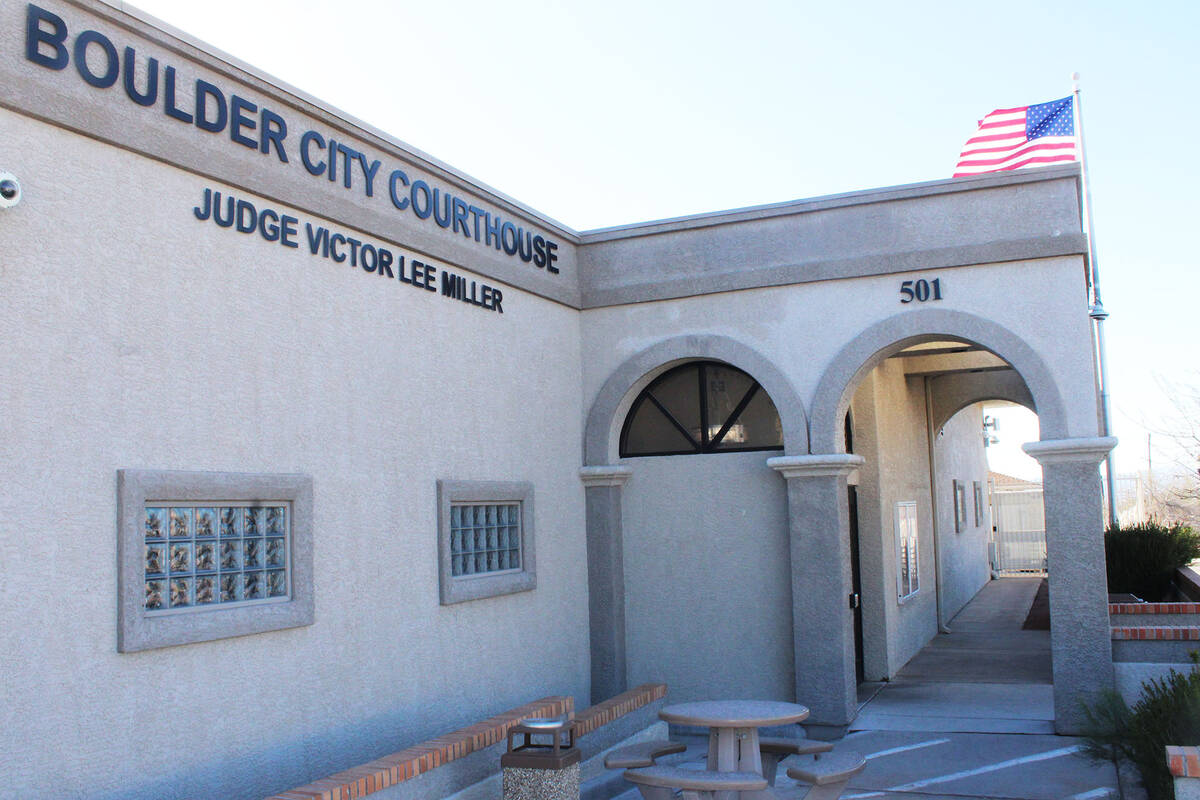
Back to the present, untangling the two posts can be difficult for the layman, but Miller patiently explained in an interview in one of his two offices in the building that house the courtroom. The robes are not the only thing that are separate. Following a fight with a Clark County official over who should be funding what, Miller has two offices in the same building, one for each position.
“The justice court has some civil jurisdiction and some criminal jurisdiction,” he says. “On the criminal side, it is all misdemeanors which, in Nevada, are offenses which result in a fine of up to $1,140 or up to six months in jail. It can take those all the way through trial and decision and sentencing. In Nevada, there are gross misdemeanors and felonies. Those cases start in the justice court as well. The complaint is filed here and then it is the job of the justice of the peace to determine if there is sufficient evidence for the case to go to trial in district court in Las Vegas, which is where the actual trial would occur.”
Complicating matters even more, in their last session the Nevada Legislature passed a law saying that anyone arrested for a misdemeanor, gross misdemeanor or felony has to have a hearing in front of a judge within 48 hours of their arrest.
“Luckily,” Miller says, “the Legislature allowed us to share with other justice courts. There are eight what we call ‘outlying justice courts’ in Clark County. So we rotate. Every morning at 9 a.m. for a week we schedule hearings in justice court and then it rotates to the next justice court until it comes back around to us in eight weeks. That was a big hassle to set up. We need a defense attorney and a prosecutor and the person being charged is in jail so we have to arrange for them to be present via video.”
And then there’s the civil side.
“On the civil side, we do cases with a value of less than $15,000, small claims up to $10,000, landlord/tenant disputes and temporary protective orders,” Miller said.
And then there is the whole world of civil infractions. Things like traffic violations that, once upon a time, were criminal matters but have now been deemed non-criminal. If you are confused about what’s what, you are not alone.
Miller was both the president-elect and then the president of the state judges’ association and worked with the Legislature as they made that civil/criminal change.
“My personal opinion?” he said. “There are 37 states that have civil infractions for minor traffic violations, including neighboring states like Arizona and California and Idaho. But, rather than take a system from one of those states that is already in place and working, we decided to invent our own wheel.”
Municipal judge is simpler. It is only misdemeanor crimes, but those crimes have to occur within the limits of Boulder City and the arresting agency has to be BCPD.
So, if you are arrested for a misdemeanor inside BC and are arrested by Boulder City Police officers, you’ll be talking to Judge Miller, the municipal judge. If you get arrested for the same crime in the same place but the arresting officers are, say, Nevada Highway Patrol, then you’ll be talking to Justice Miller, the justice of the peace. Again, pay attention to the color of the robes.
The election for justice of the peace will take place in June at the same time as primary elections for state and federal legislative offices and for the Boulder City Council. The filing period for candidates for that race is already closed and there are three who have declared: attorney Lauren Szafranski, attorney Christopher Tilman and former city attorney Steve Morris.
Most of the candidates have some interesting history. Szafranski’s husband Dain is currently the marshal for the municipal court and recently filed a complaint with the state attorney general alleging an open meeting violation by the city council in their deliberations about short-term rentals in the city.
Morris was fired by a previous iteration of the city council and sued. The current council approved a settlement of more than $600,000 to settle that lawsuit.
The new justice of the peace will take office in January of 2025. Judge Miller will retire as municipal court judge and the city council will need to appoint a replacement.
While there is no legal requirement that the justice and the judge be the same person, it has been the case almost continuously since Clifford Segerblom (the father of Clark County Commissioner Tick Segerblom) filled both positions back in the mid-1960s.