Lake Mead may see less water than expected
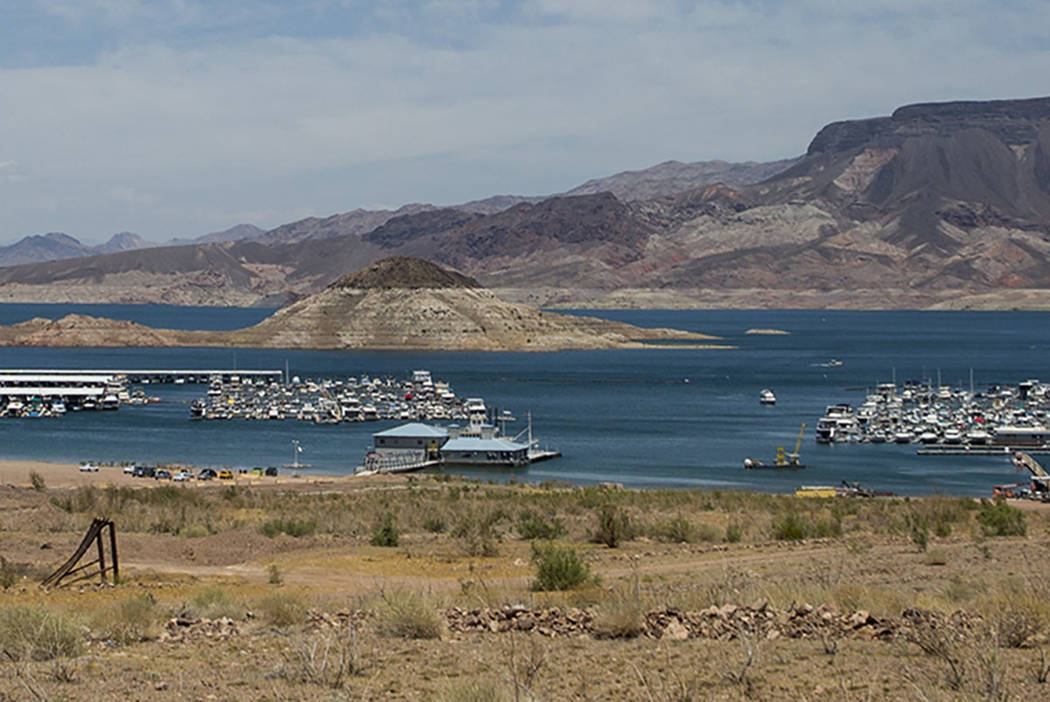





Several hundred billion gallons of water vanished from federal forecasts for Lake Mead over the past two months, but Bureau of Reclamation officials insist there’s no reason to panic.
In April, the bureau was predicting that the man-made lake east of Las Vegas would finish 2018 about 21 feet higher than it is today. Now the bureau is forecasting a 4-foot drop in the surface of the reservoir over the next 18 months — a difference of 25 feet.
But not to worry, said Rose Davis, spokeswoman for the Bureau of Reclamation in Boulder City. It’s too soon to say which scenario might turn out to be true.
“The farther out you get in time, the more uncertainty you get in the numbers,” Davis said. “They will get better, hopefully, if we get another good winter.”
The Colorado River gets most of its water from mountain snow in Colorado, Utah and Wyoming that melts between April and July. This past winter saw higher than usual snowfall in the mountains that feed the river, but that won’t result in quite as much additional water as forecasters originally anticipated. In April, they expected the Colorado to see flows 30 percent higher than average, but now it looks more like the flows will exceed the average by about 16 percent.
The bureau released its latest forecast for the river and Lake Mead last week as part of its monthly operational study, which predicts the most likely reservoir conditions over the next two years.
The dramatic change in those projections over the past two months also illustrates how much of the reservoir’s fate is determined by policy, not Mother Nature.
The coordinated rise and fall of Lake Mead and Lake Powell upstream is governed by a complicated federal framework, implemented in 2007, that is designed to protect minimum water levels in the nation’s two largest man-made reservoirs through 2026.
In April, it looked as if the water would be high enough in Lake Powell and low enough in Lake Mead to trigger a much larger release than usual downstream to Mead in 2018. Forecasters now expect Lake Powell to fall just short of the so-called “equalization” level, resulting in a more modest water release.
Davis noted that even under the new, less promising projections, Lake Mead is still expected to be just high enough on Jan. 1, 2019, to avoid triggering the first federal shortage declaration on the Colorado River. Such a shortage would require Arizona and Nevada to reduce their use of water from the river.
Contact Henry Brean at hbrean@reviewjournal.com or 702-383-0350. Follow @refriedbrean on Twitter.
How much water is that?
Over the past two months, federal forecasters have significantly reduced their projections for the water level in Lake Mead. Instead of gaining about 21 feet between now and the end of 2018, forecasters now expect the lake to lose about 4 feet.
So how much water does that 25-foot difference represent?
Every foot in Lake Mead contains roughly 100,000 acre-feet of volume, so the recent adjustment by forecasters amounts to 2.5 million acre-feet of water. That’s equivalent to 814.6 billion gallons, which is enough water to supply the Las Vegas Valley for about a decade.