Council gets crash course in road repairs



No, this does not mean that every street in Boulder City is about to get rebuilt.
In what is best described as an “informational presentation,” the City Council got an education about the system that the Public Works department uses to grade roads. That’s grade as in pass or fail, not grade as in “make level.”
The education was provided by Michael R. Dunning, Ph.D., who is an associate at NCE, who provides training and presentations about pavement design, maintenance and rehabilitation strategies.
NCE describes themselves as a “full-service civil engineering, planning and environmental firm specializing in the innovative and creative design of infrastructure projects.” The firm was founded in 1990 as a transportation research and pavement management firm working with the Federal Highway Administration. Since their founding, the firm has been the execution arm of the federal government’s Long Term Pavement Performance for which it has billed more than $37 million for pavement performance analysis and monitoring. They monitor more than 1,000 test sections across the U.S. and Canada.
This presentation focused heavily on what is called PASER — Pavement Surface Evaluation and Rating. In short, it is a way for governments and other agencies involved with roads to inventory their byways and determine an objective way to describe the condition of the pavement in order to set priorities for projects as well as developing maintenance and rehabilitation strategies.
PASER, developed by the University of Wisconsin-Madison Transportation Information Center, uses simple visual observation to rate the condition of a road. Ratings of 9 or 10 indicate all is well. By the time you get to a 7, routine maintenance is advised including crack sealing and minor patching. A rating of 3 or 4 calls for structural changes and a 1 or 2 means reconstruction.
The ratings can point to wildly different economic outcomes. Preservation efforts for roads rated 8 or higher may be as low as 20 cents per square foot. Roads rated at 1 or 2 on the scale could cost as much as $5 per square foot to reconstruct.
Do the math. A one-mile length of 20-foot wide road could come in at $528,000. (5,280 feet in a mile means 105,600 square feet in a 20-foot wide road. Multiply that by five.) And according to city staff, the budget BC has in funding, that comes from the Regional Transportation Commission for general road repair, is in the neighborhood of $2.1 million per year. That puts those number into some kind of rough context.
The kinds of damage include bleeding, which Dunning said is common in Southern Nevada and results from there being too much oil in the initial mixture. Over time, this migrates to the top and makes the road look like it is constantly covered with water.
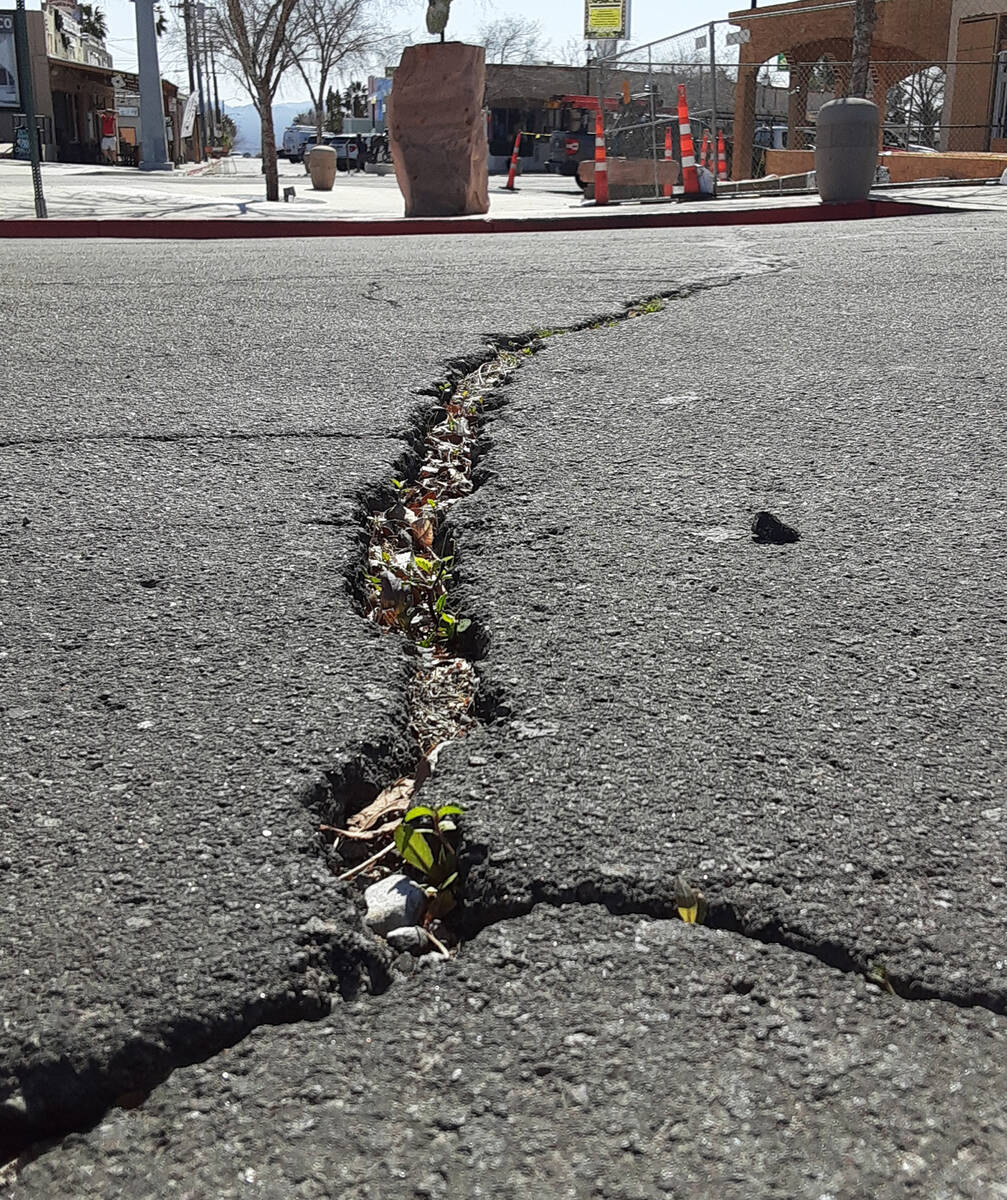
Then there are many kinds of cracks. Block cracks look like squares of the pavement have been broken out. Alligator cracks obviously take their name from the texture of that reptilian hide. There are transverse cracks and reflection cracks and rutting and settlement upheavals. And all of them lead to the dreaded pot hole.
Those who drive regularly on less-than-optimal roads might not like the next part.
Talking about how priorities are set, Dunning said, “The theory is that you treat your best areas first. The reason why is that it costs less money to repair those areas.”
“It’s not about actual repair,” said Public Works Director Jamie Curreri. “It’s about cost of treatment. When we talk about doing the best roads first, it means we prioritize maintenance so that those roads don’t get worse.”
When asked by Mayor Joe Hardy where the city was in terms of maintenance, Curreri reported that the city is behind but moving forward. He said that the road preservation projects for fiscal year 2024 were about to start and the first step would be crack sealing because that process is more effective when the roads are cooler.